Sunday, October 17, 2010
Following BourbonHawk: Birding Away From The Rock
11:57 PM | Posted by
Sweep Commander |
Edit Post
I'll pen another sarcasm laden post soon. Tonight, we're all business.
America's National Park System is an entity with so infinitely many virtues that if you began to list them, you'd just never finish.
The genesis of Golden Gate National Recreation Area, of which Alcatraz is just one facet, came partly through the enlightenment of Congressman Phillip Burton, representing at times, California's fifth and sixth congressional districts.
Prior to his conversion to the righteous cause, he saw the maintenance and preservation of public land as a distraction from his true mission in government, lessening the economic hardships shouldered by blue collar America.
He only concerned himself with the fate of public lands when it was explained to him that rich folks have their own lakes, their own yachts, their own snazzy houses on the shores of said lakes.
Shouldn't everyone else at least have the pleasure of walking along the shore of a lake? I mean, at the very least? For Burton, that was all it took.
By the way, it was his strategizing and haranguing that gave Alcatraz to GGNRA. If our urban park has a founding father, well... But enough about him for now.
As awesome as the Golden Gate National Recreation Area is, it's not the only name in the public land conservation game.
Adventuring off the reservation
Out of the park
Out of the National Park System
Out of the park
Out of the National Park System
I love BourbonHawk's idea of covering bird life throughout the GGNRA. In the spirit of that temporary journey away from Alcatraz, here's a trip even further afield.
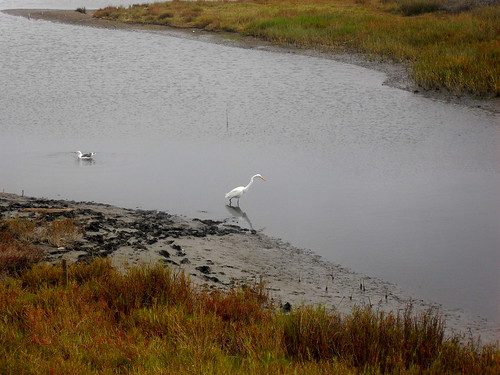
Last weekend, my father and I hiked Rush Ranch, a piece of land on the Suisun Marsh, waaaay over there in Fairfield. It's maintained by a nonprofit called the Solano Land Trust and to be sure, we had a fantastic time. There were raptors everywhere:
Seeing all of the hunting sites around Rush Ranch also gave me pause. I'm a huge animal lover and a strict vegan. I've been a vegetarian since I was around 10 or 11, if I remember correctly and I can still remember my last box of Burger King's chicken tenders which had satisfied me so reliably.
I've been a very good liberal about hating guns and hunting, thinking it cruel and unnecessary, not quite seeing the point.
On reflection, however, I think going out and dispatching your own meat is far better than getting it from the factory farm. These hunted birds live their wild lives, enjoy their natural diet in the comfort of a habitat protected from human encroachment. Those that do fall at the guns of hunters may experience brief periods of suffering prior to their deaths, but animals in factory farms endure pain and mistreatment throughout their entire lives.
Sure, if you're a duck, it sucks to be shot. But there are innumerable hawks, eagles and falcons to remind us that when you're a plant eating marsh bird, mortality is part of the equation and every single one of these raptors has to find, attack, kill and eat an animal every single day.
Hunting also seems far more environmentally friendly and sustainable than factory farming. Factory farming is not inextricably tied up in the business of conservation. Hunting absolutely is.
Though I would never, ever, ever go on a hunting trip or kill any animal bigger than a spider, it does at least seem to be a nice day outside with the family, in a country where people spend far too much time in front of screens like this one.
Finally, from my dear father's collection, you can get an even better sense for the ecological richness of this place. You see, he's a better photographer and he's got a snazzier camera. I can promise you an extra cool picture of a red tailed hawk diving on a juvenile golden eagle. So rad.
Next time: back to Alcatraz.
Saturday, October 16, 2010
A New Feature: Birding around the GGNRA
2:13 PM | Posted by
BourbonHawk |
Edit Post
As many of you are aware of, Alcatraz is part of a larger national park known as the Golden Gate National Recreation Area. This park is a group of sites maintained by the National Park Service around the San Francisco Bay Area and constitutes one of the largest urban parks in the world.
While we certainly intend to keep the focus of this blog on Alcatraz and the birds we find there, there is a really great amount of bird life to be found in our other park sites as well. Having spent a little while at Crissy Field yesterday, I figured I'd kick off this installation with a few shots from yesterday and from the past that I've taken there.
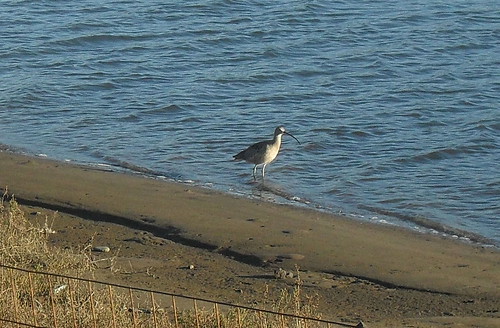
Long Billed Curlew

Black Bellied Plover

Ring Billed Gull
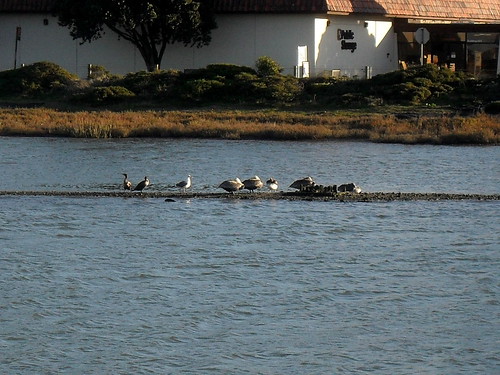
Cormorants, Gull, and Brown Pelicans
The nicest thing about a site like Crissy Field is that it's very easy to see all sorts of bird life without having to trek far, break out the binoculars, etc. It's right there in front of you. In hanging out there for about half an hour yesterday I saw the following birds:
1. Red Tailed Hawk
2. Red Shouldered Hawk
3. Brandt's Cormorant
4. Double Crested Cormorant
5. Brown Pelican
6. Western Gull
7. Ring Billed Gull
8. Snowy Egret
9. Great Egret
10. Black Bellied Plover
11. Unknown Species of tiny, tiny Plover
12. Unknown Species of medium-sized Sandpiper
13. Killdeer
14. American Coot
15. Unknown species of Tern
16. Crow
17. Common Raven
18. Black Crowned Night Heron
19. Mallard
20. Tons of little tiny songbirds that I have no idea about
This also makes it a great site for the beginner or the casual birder, which I still sort of feel like I would be categorized as, not having a huge amount of field experience other than what I see on hikes or out there on the island.
Wednesday, October 13, 2010
Returning falcons confound and excite the island's bird detectives
9:52 PM | Posted by
Sweep Commander |
Edit Post
Oh yes. Our falcons have returned.
Or at least we think they're our falcons from last winter.
Long story short, in late November 2009, I spotted a lightly colored bird standing straight up atop one of Alcatraz's tall cypress trees. It was far away, but its vertical silhouette seemed very out of the ordinary. I pointed it out to Ranger John and asked him to identify it. He nailed it on the first try. It was a peregrine falcon.
The bird, which turned out to be a female, was then joined by a juvenile male. The two remained loosely allied throughout a winter of fun and brutality, feasting on European starlings and unwary seabirds. In their spare time, they provided drama for the usual bird bosses of Alcatraz, our very large and extremely territorial pair of common ravens.
One day in March, our female enjoyed one last meal on the top of the power plant's smokestack, spread her wings like sails into the wind and left us for the summer, presumably to breed with a sexually mature male in a territory somewhere to the north.
The male was last seen at June's closing. Before that, his relationship with Alcatraz seemed more and more tenuous... some experts judged that he was holding Alcatraz as a future breeding territory. The possibility was exciting, especially for those of us who had first participated in discovering and observing him. Alcatraz has never hosted breeding peregrines before. Given the summer population of 1,500 to 2,000 large and aggressive gulls, no one was even sure that breeding peregrines were a possibility. To our dismay, the frequency of peregrine observation was declining, finally approaching zero.
And then...
Last Sunday, October 9th, I saw a male peregrine falcon with mixed blue and brown plumage on the Alcatraz lighthouse, in the exact same spot that I'd seen our male all of last winter, and indeed, at the same time in the early evening. His prime viewing hours are 5-7 pm.
The blue and brown feathers indicate that the peregrine is in transition. He's shedding its brown juvenile quills and donning the prim and chivalrous blue coat of a breeding adult warrior.
The very next day, still stoked from the rediscovery of our male falcon, I made another find: an adult female falcon in the very same cypress tree that our female falcon from last winter preferred. For me, as a birder of The Rock, this was a huge personal lift. BourbonHawk and I have spent countless hours stalking and observing this falcon, neurotically checking her perches even when she had been absent for months. She is the raison d'etre of this bird blog.
But is it the same falcon pair from last winter?
As it turns out, falcons don't wear name tags. Hell, falcons not obsessively stalked by unstable birders don't even have names. Confirmation that the falcon you saw today is the same bird you saw several months ago isn't easy to produce and in the male's case, there may be reason to doubt his identity as our heroic but moody tiercel from the winter of 2009 and 2010.
His age, given away by his plumage, is a perfect fit. His blue and brown feathers firmly indicate that he hatched in the summer breeding season of 2009, just as our falcon did. He sits on the same east facing ledge of the Alcatraz lighthouse at the very same time of day. He looks to be about the same size.
None the less, we can't be sure that he's ours. In June, we saw another male falcon undergoing the same transition from brown to blue. If the two had been the same bird, it sure seems as though the molt would be complete by now. As it stands, we can't rule out the possibility that we've been mistaking two male falcon yearlings for just one.
On the other hand, artifacts of digital photography and bad early evening light in a fog ridden context could also be distorting our sense for his coloration.
One raptor expert told us that the preference of two similar falcons for the same roost might be explained by the attraction that they have for the aggregated guano of other falcons.
None the less, my intuition that this is our same falcon is bolstered by the fact that since May, Alcatraz has had a brown falcon sporting one or two blue feathers. With every observation of a falcon in transitional plumage as the year went on, the blue went up and the brown went down. Call me crazy but I think it's the same bird, even if it's taken several months and our intuition is that the whole blue to brown molt should happen inside of 30 days. (Important to keep in mind: every time I assert a suspicion without concrete evidence, I seem to be wrong. Example: the time I wrote about a thousand words on how the raven pair was deceiving the National Park Service and incubating a nearly unprecedented second clutch of eggs)
The identity of the female seems less mysterious.
Unlike at the lighthouse, her cypress tree doesn't have aggregated guano on it, and she hangs out in each of its boughs and branches without regard for the presence of peregrine droppings. Call it a subjective unscientific judgement, but she seems comfortable and very much at home in this tree.
Watch out, ravens...
The presence of a pair of adult peregrines on Alcatraz should strike fear into the heart of the island's ruling pair of majestic corvids.
The relationships between ravens and raptors are varied, complicated and potentially violent.
There are recorded instances of ravens killing falcons and falcons have certainly put an end to many a proud raven. Falcons, transcending their smaller size, have even killed golden eagles, some of the most fearsome raptors the world has to offer. The warlike behavior of our young male last winter, attacking any bird of any size from large gull to large raven, gives me every assurance that he is an aggressive creature that fears nothing but a lack of suitable targets.
On the other hand, there is also evidence that ravens and raptors can live in cooperation with one another, especially after a period of years in close proximity. The raven and raptor pairs come to accept the presence of the other and there is even some evidence that they share defensive duties and come to understand one another's alarm calls in the case of an unwanted invader.
In peregrine falcons and common ravens, you have two of the smartest and most complicated minds in the avian world. Concrete expectations for how the two pairs might interact are bound to be a source of frustration and disappointment. Still, up to this point, it's been all fistacuffs, and I doubt the ravens are happy to see our falcons return.
Coming soon:
-How the female falcon is a product of the sexual revolution (hint, she has a boy and a house for the summer and another boy and another house for the winter.)
-How long has Alcatraz had seasonally resident falcons? There's reason to believe that it's longer than we think.
Lastly:
There are those that take our aforementioned ravens to be "nasty birds", worthy of little more than target practice for our capable and burly law enforcement rangers.
I would make the case that while they are carrion and trash eating voracious predators, they are also the most committed couple the island has to offer.
The other day, BourbonHawk remarked on just how odd it is that we never see our ravens eating carrion... then we saw this:
Yes, that is the foot of a tiny dead bird, attached to its downy fluff.
They'll even eat the cutest baby gull if it pleases them...
Nasty? Perhaps, but unlike our sexually liberated falcon femme, these two stay together at all times during the year, abiding by each other, feeding, preening and keeping each other company. Falcons should be wary because these ravens will certainly protect each other.
Subscribe to:
Posts (Atom)