Wednesday, May 19, 2010
 Mommy, what is "stacking"? Also, babies, babies, babies!
In polite company, we don't say these gulls are mating. We don't say they're courting or consummating their monogamous bond and for God's sake, we absolutely never say that they are engaging in the sexual exchange of genetic information necessary in the natural course of human and animal reproduction! No; feel free to take your child to Alcatraz, because the closest thing you'll hear to a four letter word on The Rock is "stacking", the eupha franca for the preceding act.
ALSO, BABIES!
Yes, these acts produce babies.
I have no fear of becoming a cutecore blog. I relish the possibility. When given the choice between more or fewer fuzzy baby animals, I'll go with more every time. Not BR00TAL or metal at all, I know.
Snowy Egrets:


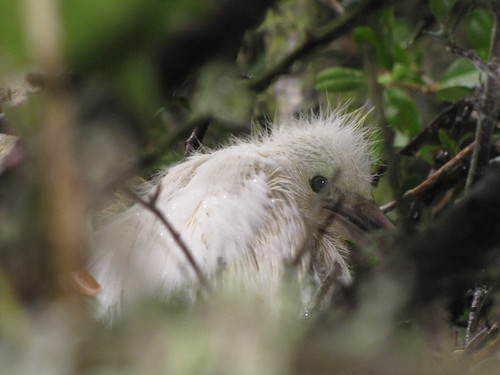
Dinosaurs, anyone?
Black Crowned Night Herons:
Hey ravens. Looks like you missed a few.

Common Ravens:
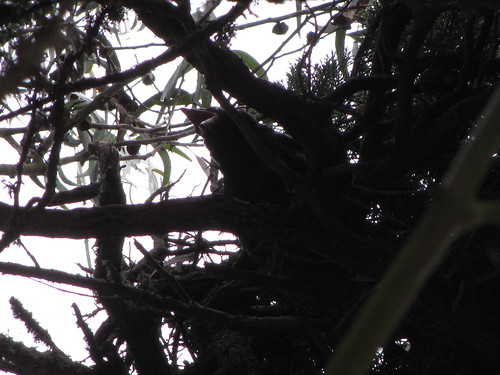
The young and thoughtful apex-apex predator leans out of the nest, vocalizes.
Dastardly bird feeds its little branchling. The little bird is hoping someday to be just as dastardly and objectionable as mom and dad.
Canada Goose!

click on the image for a larger size
Our last gosling says: "I'm gonna get THIS BIG!"
Saturday, May 15, 2010
the tales that odd plumage will tell you
I'd been working on a few separate posts that in one way or another involved unexpected plumage and what you can know about a bird from an odd feather here or there. So, hell. It's one post now. Here we go.
This is a leucistic western gull that I met at Stow Lake in Golden Gate Park. Leucism is a condition which causes the afflicted to display unusually low levels of body pigmentation. It's similar to albinism, differing in ways I don't fully understand, but I do know that the presence of standard eye pigmentation is enough to establish that this guy is leucistic and not a true albino.
A google search revealed a report in the San Francisco Chronicle that an albino wegu hatched on Alcatraz in the summer of 1997. After I tracked down a former Alcatraz bird biologist, he informed me that the item was incorrect and that the hatchling in question was in fact leucistic! EUREKA!
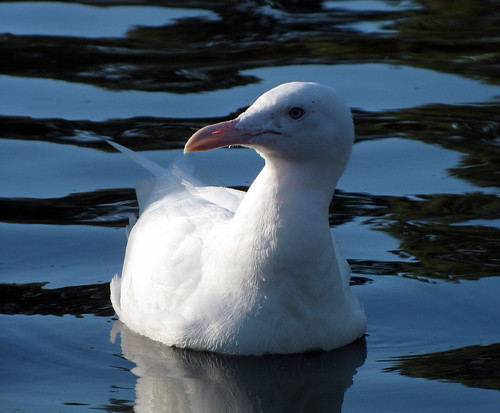
With these birds quite often reaching fifteen years of age, it suddenly seemed possible that the leucistic gull of Golden Gate Park might have origins on Alcatraz.
Alas, the same bird biologist immediately informed me that the leucistic wegu disappeared while fledging, probably killed by a fellow gull or some other predator. Sometimes an investigation is dashed the moment it peeks your interest.
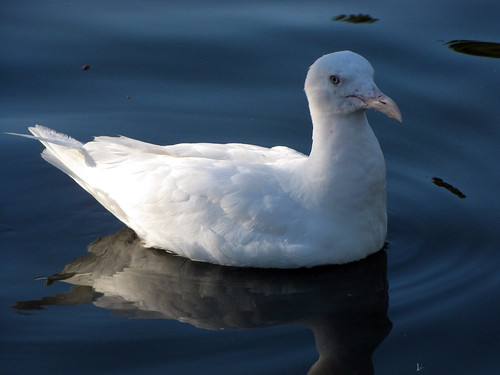
Still, we may be able to salvage an ounce of intrigue here. While this bird may not be a product of Alcatraz's gull colony, it may be the same as individual as this one, which visited Monterey over the winter of 2003/2004. The bird appears identical, and while that fact alone doesn't prove anything, this state of near complete leucism can't be all that common.
Other forms of aberrant plumage are far more common and a bit less intriguing:

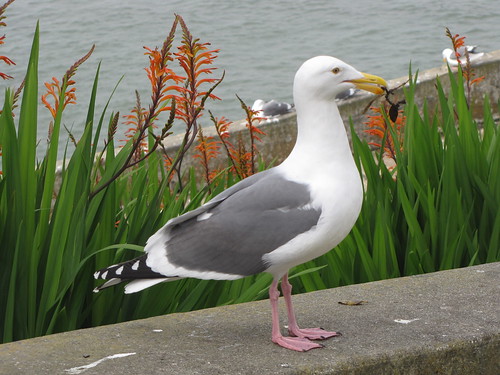
In birder jargon, you'd say it lacks the typical mirrors on its outer primaries. In plain english, this gull's rear end, which is actually just the ends of its folded wings, lacks white spots. The following bird is a typically plumed wegu:

Sometimes odd plumage can indicate that the gull belongs to a different species entirely.

I captured this one flying over the island last winter. Superficially, it looks very similar to the gulls that make their home on Alcatraz.
But a closer examination reveals that unlike a western gull, this guy's head gets dark smudges during winter and it has grey -not black- wingtips. That's because this is a glaucous-winged gull, a close relative of our resident gulls, but a slightly larger, colder weather variant on the theme.

And what do we make of this bird?
We spotted this oddity nervously treading Alcatraz's parade ground over the winter. Unlike a western gull, it has a smudged head. Unlike a glaucous-winged gull, it has black wingtips.
It's a potential hybrid between the two.
Western gulls and glaucous-winged gulls hybridize freely along a stretch of coast extending from the border of Oregon and Washington up to the Canadian border. There, intermediate birds outnumber pure birds of either pedigree.
After observing many strange gulls over the winter with some visiting from as far north as the arctic, I've begun to wonder how gulls decide where to winter and where to establish themselves and breed.
Will birds be loyal to their winter haunts or could they spend one winter in Monterey and a few years later decide that Golden Gate Park is the place to be?
These are birds that take four years to develop their adult plumage and breed, meaning they have four years to explore. While there's apparently no truth to the rumors that this is part of the gulls' traditional variant on the Amish tradition of rumspringa, or that they spend this time backpacking in Europe, they may very well use these years to get a sense for preferred breeding and wintering grounds.
Lastly, when two gull species hybridize so extensively (and many others do as well) it poses serious problems for our general concept of a biological species. That's certainly the subject of a post to come.
 Labels:

Friday, May 14, 2010
Bird Census: American crow

Likes: Intelligence tests suggesting they might be among the smartest of nonhuman animals, carrion, tiny animals, infrequent tool use, nuts.
Dislikes: The West Nile virus, which has reduced the American crow population by half.
Monday, May 10, 2010
Update on our brave young falcon, raven news

Our resident falcon needs a name! We've come up with the following possibilities:
1. 'Greg' (to honor the great and fearless leader of the Golden Gate National Parks Conservancy) Personally, I favor this.
2. 'Judas' (one Alcatraz regular, speaking to us in a thick Irish accent, convinced us that it would be dramatic and rad to have a peregrine falcon named Judas marauding around a lonely and decommissioned island prison at over 200 miles per hour, chewing the heads off invasive European starlings left and right. We found it hard to argue)
3. 'Tiercel the tiercel' (Yes, it's very literal and one-to-one, but once we all lose our taste for absurdist and meta forms of humor, 'Tiercel the tiercel' will seem cheeky, refreshing and sensible)
4. 'Maganrord' (Well, we did discover the damn thing, but that would be way more self aggrandizing than even we can stand. And yeah, that's saying something)
What do our readers think? Send us your ideas!
Though I don't have any real news on the little guy, I do have a cool video of him diving on the raven pair and dogfighting with some gulls over the black crowned night heron/snowy egret colonies on the west side of the island. Enjoy.
Our falcon is the fleet little gentleman appearing about three seconds in.
A word to our ravens: don't you guys have two newly hatched chicks? What are both of you doing on the other side of the island anyways? Did those chicks fail? Was our source on them bunk in the first place?
Well, the above video is two weeks old. This afternoon, we saw tree climbers ascending to the ravens' nest on pulleys. I saw a black bag go up the tree as well.
There was a report that raven chicks had already hatched, but the ravens' recent behavior which has included leaving the nest together for extended periods of time, gathering nesting materials instead of food and declining to defend the tree from birds and humans alike, doesn't align itself cleanly with that of a pair caring for hungry and defenseless hatchlings.
What were the climbers doing up there? Oiling a new clutch of raven eggs?
Being a bird detective is hard! We'll report what we find.
Saturday, May 8, 2010
is the last Alcatraz gosling too big to fail?

Alcatraz is down to one final gosling. With this fledgling having achieved a formidable size and with the fresh water provided by today's rain, the bird's odds of ultimate survival aren't bad at all.
Though it's hard to know just how many pairs of Canada geese we have breeding on Alcatraz, my estimate is that around ten pairs, give or take a few, produce offspring. These geese lay around 8 eggs, meaning that perhaps 80 goslings hatch on Alcatraz each year. The number will be lower if fewer eggs are laid or if some are predated or fail.
One surviving gosling seems like an astonishingly low number given the large numbers of baby geese this year, but one survivor is actually an astonishingly high number given that once hatched, every Alcatraz gosling is equal parts of cute and vulnerable to gull and raven predation.
Their prospects for survival are understood to be zero, though there is a rumor around the island that years ago, one heroic Alcatraz gosling fledged. In the usual case, the goslings are so consistently predated that a park service intern from an Alcatraz summer past once referred to these fluffy cuties as "crunchy gosling snacks". One park ranger refers them to them as "an island delicacy". Another island staff member calls them "popcorn".
The factors limiting their reproductive success on Alcatraz are self evident. Fresh water for drinking is limited, perhaps driving families of geese to be territorial over scarce resources, driving aggression towards each other and diverting their attention from the danger posed by predators. Meanwhile, opportunistic and wily gulls and ravens predate young geese with interest. Their parents are aloof and hapless defenders, often wandering too far from their defenseless young to defend them from predators that know the dance all too well.
Recently, LadyBird, BourbonHawk and I were hiking Stowe Lake in Golden Gate Park when we became witnesses to tragic circumstances. A group of young children, ranging in ages of around four to seven years old, were trying to throw white bread for a family of four adult geese and eight goslings that were happily grazing on their natural diet of grass.
The geese were barely interested, hesitantly munching on a few crumbs. The loose bread, however, attracted gulls and while they came for the bread, they stayed for a gosling. The parent geese hissed at the children for getting too close but their hisses and threat postures are so unthreatening that the children were not even aware that they were being challenged. While the adult geese were preoccupied with the children, a gull snatched a gosling and after the gulls fought over the dispatched chick, they disinterestedly allowed it to float in the lake before one gull finally swam over and swallowed it whole.
Two onlookers loudly and naively exclaimed that these murderous gulls have no sense for their own immoral behavior. When you watch gulls for a while, you get it. They eat trash and kill the weak, young and defenseless. They make their living by being above nothing and they do very well.
For any adult geese reading this post, I have some words of advice.
First of all, weaving your head from left to right and hissing quietly at a perceived threat is not a defensive strategy. More honking, charging and erratic, unpredictable movements would better alarm potential predators. Also, kill or maim a gull every now and again. When a gull is six inches away from you and your young and your lame threat posture won't phase it, bite the bird's neck!
Also, don't reproduce on sandstone islands with thousands of gulls and no fresh water.
The geese on Alcatraz have very limited fresh water resources so they are very territorial about what's at hand. By contrast, the geese at Stowe Lake aren't faced with these limitations, so they can pursue more advantageous strategies including the formation of a crèche, a cooperative grouping of multiple pairs in which defensive responsibilities are shared by four or more adult geese instead of the usual two.
We'll keep you updated on our miracle gosling.
Odds, ends:

Today, I noticed that at least five California gulls have staked out an enclave near the old prison incinerator, on top of the old, now defunct brandt's cormorant colony (more on that soon).
This is rad because the ubiquitous gulls on the island are western gulls and California gulls are invisible by comparison. I had been working on Alcatraz for more than a year before I finally spotted one of these.
Next thing.
Although the cormorants have left this nesting site for areas around the island far less friendly to observation, it's nice that a few of the island's locally rare birds may be setting up shop on this stage. I guess the old saying is true, God never closes a door without opening up a window nature never starves a thousand cormorants without giving you five uncommon gulls to observe in return.
Our snowy egrets have chicks! There are no pictures because these birds nest in thickets and having your camera focus on an object with 50 twigs in front of it is difficult work.
Lastly, I've been seeing these around the island. Does anyone know what I can do with them? Shoot me an email.

Young ravens hatch, parents behave cryptically (and what else is new?)
.JPG)
I don't blame you guys for not reading or responding to my last post. I can't help getting a little way too nerdy with it sometimes.
Though we've been slow with updates lately, every day this week we'll be hitting you with real birding news from Alcatraz that you might actually be interested to read, complete with the rad photos and videos you've become accustomed to.
Tonight, we'll start with the island's common raven pair as they've been behaving strangely.
We at Maganrord have it from a reliable source that two raven chicks have hatched, and so it goes for the park's efforts to hinder them through the oiling of their eggs and the dismantling of their nests. The ravens also produced young last year despite the park's best efforts to thwart them.
Now, oddly enough, the ravens are not visibly gathering food for their young but are gathering fresh nesting materials instead.

Did their two chicks fail? Are they rebuilding the nesting structures that were recently dismantled? Will they lay a second clutch of eggs as they apparently did last year after their first was oiled by the park service? At the moment, we don't have much to go on.
Two weeks ago, BourbonHawk and I found the bloodied head of a tiny bird, as well as scattered pale green eggshell fragments along the side of the cellhouse.
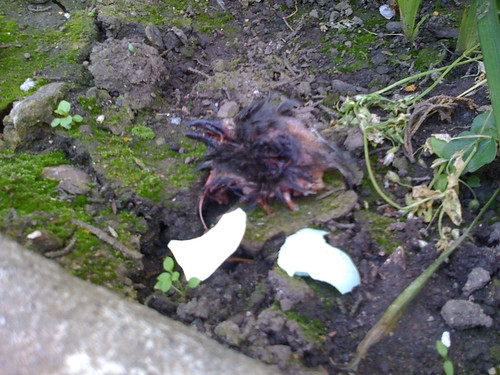
It's typical predation by our raven pair. BourbonHawk took the picture. The male raven was hopping around above us, looking down from the roof of the cellhouse as I made this discovery. Both the snowy egrets and the black crowned night herons lay eggs of this color.
The park gives the ravens' predation of the black crowned night herons' eggs and young as the primary justification of its raven management policies. These include oiling their eggs and dismantling their nesting structures.
The black crowned night herons themselves are known for predating the eggs and young of other vulnerable nesting species. Though the irony of their own young being predated is rich, and though our two common ravens are exceptionally huge, there is apparently no truth to the rumors that our common ravens are on a mission from God to exact a penance from black crowned night herons at large. It's just what birds do.
We at Maganrord have to confess the following: observing the ravens is perhaps the most rewarding birding to be had on Alcatraz. Aside from Canada geese and brown pelicans, these are the largest birds we have. These creatures are majestic, imaginative, fierce and intelligent. Rather than being perceived as invasive and dangerous pests to be managed, we would have them observed and appreciated as the compliment to Alcatraz's ecological riches that they very truly are.
Earlier in the year, we observed them tearing up the anti-erosion netting that protects the western beds of Persian carpet flowers. Though the ravens are mischievous, they aren't acting solely to cause headaches for the Garden Conservancy volunteers that care for our gardens. They're out to line their nest with the netting, which has the tactile quality of a burlap sack or twine. Ravens are known to line their nests with moss or fur, but the netting protecting the Persian carpet is plentiful and retains its softness over time.
Note that the confused gull in the upper right corner watches the raven and then sheepishly picks up strands of the netting as if to ask, "What's this craziness for? Can I eat this?" Eventually the gull shows its smaller intellect, understanding only the inedible nature of what it's got. It drops its cargo and goes back to work doing mundane gull things.
Are these ravens really bad news for the black crowned night herons? Absolutely. But the night herons' prospects are hardly enhanced by sharing a small breeding colony with over two thousand large gulls. In fact, though we are absolutely amateurs and our opinions on these matters should be suspect, our review of the available studies indicates that the presence and reproductive success of black crowned night herons is hampered primarily by the gull colony and even inversely correlated to its size. These studies name gulls as competitors to herons for nesting sites and food resources as well as significant predators of the herons' nests and young. We at Maganrord have been joking for some time that if you want to help the black crowned night herons breed on Alcatraz your management policy should be to downsize the gull colony, perhaps by half. The studies available suggest gull management, but we don't anticipate that happening any time soon.
By contrast, the ravens seem to be justifiable targets, as according to some, they are expanding out of their prehuman range.
Other studies indicate that black crowned night heron reproductive success per nest at Alcatraz has in recent years been far lower than at other San Francisco Bay island colonies. Paradoxically, more productive night heron colonies have collapsed and disappeared while the low-output night heron presence on Alcatraz has grown in size.
North bay black crowned night herons may have preferred Alcatraz in recent years, but they have had a number of difficult years here. Encouraging them to settle elsewhere in the bay may be worthwhile.
It's also worth noting that while we're engaging in management policies to limit the spread of the common raven and lessen its impact on the local black crowned night heron population, this heron is one of the most successful species in the world, breeding on five or perhaps six continents and needing no help (other than perhaps feathered hat enthusiasts not killing them for their plumes) to thrive.
On the subject of the raven management policies there is just too much to say and it sounds like the subject of a long and nerdy future post.
Saturday, May 1, 2010
Gull fights revisited
Let's get nerdy for a minute.
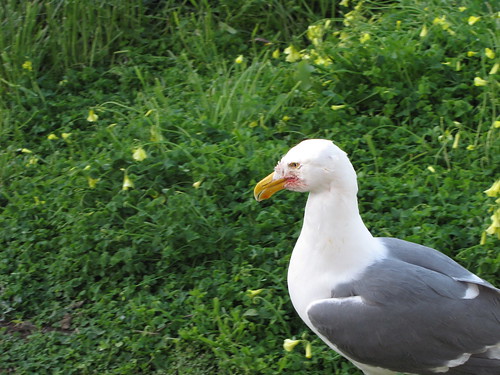
A while back we managed to record a 27 minute gull fight, which by one visitor's testimony, began with an argument over a morsel of chicken.
Whenever I witness such a pointless exercise, I wonder how the larger taxa of gulls could possibly have achieved unfathomable numbers and worldwide distribution when they are prone to costly fights with trivial causes. Why hasn't natural selection blessed them with calm breeding colonies where gulls treat each other with trust and deference, looking after one another, only turning their wrath on malicious intruders?
Evolutionary biologists sometimes refer to a very beneficial adaptation of form or behavior as a "neat trick".
My first thought was that the gull's basket of tricks is so collectively neat that the group can afford to loose a little blood at the margins, especially as the camber of a gull's wing was once described by Stephen Jay Gould as the nearest nature comes to perfection. Also, these guys eat trash, and we make tons of trash. That's the neatest of tricks.
But this explanation of gull on gull violence doesn't seem to work, at least at first. A species may tend to acquire traits that are maladaptive in one regard, e.g. cormorants becoming heavier and so losing their ability to fly proficiently, but it only adds up if in so doing they are improving themselves in another regard, e.g. cormorants becoming heavier and thus more proficient divers. The flightless cormorant has made an outright exchange of its flight capabilities for a body that is singularly adapted to life in the water.

You might think that a gull could hold onto all of its neat tricks of wing design, omnivorous diet and trash consuming opportunism while still being more socially amicable. But this hasn't materialized. What is going on?
The difference between the fitness of an individual and the fitness of a species may provide us with half of an explanation. If all gulls were friendly to their fellow colonists, this would undoubtedly be good for gulls collectively, but it wouldn't benefit individuals who have something to gain from harming their conspecific neighbors. After all, these are creatures who occasionally meet their dietary needs by killing and eating the young of their own species.
The Irish elk is familiar with the difference between collective and individual fitness, or at least it was before it fell into extinction around eight thousand years ago.

Success in the fight for mates is believed to have been partially determined by the size of an individual's antlers. As you might imagine, the antlers grew large and unwieldy. The devlopment of traits that were good for the individual were bad for the survival prospects of the species, possibly bringing it to the point of extinction. The narwhal may be undergoing a similar process if sexual selection is causing the size of their otherwise useless tusks to grow over generations.

Perhaps the popularity of these violent traits among gulls can be partially explained by understanding how they benefit the individual gull who displays them rather than all gulls at large. I'd imagine that arriving at a gull colony like Alcatraz is a little like arriving at a functioning prison in that the sage advice is to find a suitable target and pick a fight over something trivial. Win or lose, it will be known that you will defend yourself, your territorial boundaries, your hard won food, your eggs and your young. It would harm your prospects if other gulls recognized you as a bird which habitually engages in appeasement to avoid violence. My guess is that this is part of the answer.
For additional clues, we should think back to the case of the cormorant taxa and their tendency towards compromising their ability to fly in order to enhance their ability to dive. Although it seems like gulls aren't trading away their ability to socialize by making an analogous bargain, on reflection, I think that they are.
Gulls are vicious predators and they're wildly successful in that regard. They are well served by yet another neat trick that is easily obscured by their superficially unobtrusive and harmless presentation. This trick is their willingness to inflict harm at the drop of a shred of chicken, to aggressively fight over any edible trash, and to attack and kill any sick, injured or otherwise vulnerable animal. LadyBird, BourbonHawk and I saw a gang of gulls butcher and eat the cutest baby geese you'll ever see.
I can't know for sure, but I strongly suspect that the gull's abidingly malevolent orientation towards all other creatures, which serves it well in many respects, is guaranteed by hormones and brain structures that are too rigid to be switched off for interactions with their own kind and on again for perpetrating violence against victims of other species.
As a result, each of our western gulls appears to be out for itself. The bloody tendencies designed to serve its feeding strategies have generalized, giving shape to each bird's interactions with its fellow WEGUs. That, and the possibility that natural selection based upon individual and not collective fitness has given form to gull social behavior, may serve to explain the paradoxical observation of two gulls fighting for 27 minutes over a 40 calories of discarded chicken.
Also, I know this wasn't news, but it's been on my mind lately. News soon to come on goslings, ravens, gulls, snowy egrets, and the world famous Alcatraz peregrine tiercel.
Subscribe to:
Posts (Atom)