Showing posts with label mallard. Show all posts
Showing posts with label mallard. Show all posts
Sunday, June 27, 2010
 Raven male defends his young; raven female is... where?

The ravens bred in 2010, but only one branchling left the nest alive. The adults watched over their young one closely and killed an adult western gull, apparently for showing a little too much interest in their pride and joy.
Then, suddenly, we went from three observable ravens to two. It seemed that the juvenile was gone. As new ravens will stay with their parents for a period of months, successful fledging and departure seemed unlikely. The speculation was of its possible demise.
As usual, the ravens had us fooled. The juvenile was still very much with us, and hiding right before our eyes. She or he vocalized softly and hoarsely while displaying submissive crouching and begging behavior typical of a juvenile or a subordinate individual in a larger group but unlikely behavior for for a breeding adult.
One mystery was solved. One of our visible ravens was the juvenile. The other was the male, discernible by its size and its trademark "fur pants" dominance display. So where is our breeding female? She's been unobserved for quite some time now.
I have a crazy hypothesis: she may be incubating a second clutch of eggs.

This would be more than unusual. It's almost unprecedented. Ravens are not double brooders, though given enough time, they will attempt another clutch if their first brood of chicks and eggs fails completely. Double brooding by ravens is so uncommon that it's only been documented in one single instance, during breeding season 2001, on the campus of UC Irvine.
My suggestion is just a hunch, but it has the following considerations in its favor:
First, there's time for a second brood. The ravens nested early this year. In the single documented case of double brooding, enough time and plentiful food resources were cited as possible factors enabling the behavior.
As for food, with a home territory like Alcatraz, with so much ecology and so much trash at hand, food wouldn't seem to be a problem.
Second, the natural resources arm of the Golden Gate National Recreation Area has visited the ravens' nest multiple times in 2010 and damage to the nest may have occurred. Just as the number of visible ravens dropped from three to two, they were observed carrying nest building materials to their tree, perhaps repairing damage their nest structures incurred. Bernd Heinrich, noted raven expert and author of the great book Mind of the Raven, observed that the ravens' cue to mate is not a ready female, but rather a finished nest.
Damaging the ravens' nesting structures may have inadvertently put them on a path towards a second clutch.

The third consideration is that while double brooding has never been documented except in the one paper I linked to, the paper's authors complain that not enough observations of this type have been attempted, especially on the divergent California clade, to which our ravens belong.
The surprising genetic differences between ravens of the American southwest and those found in all other contexts will be addressed in an upcoming post laying out what little we know about Alcatraz's raven pair.
The last consideration I'd offer in favor of the double brooding hypothesis is that Bernd Heinrich also says that if a raven minding a home territory loses its mate, he or she will find a replacement quickly, often within a day. That hasn't happened, though another plausible explanation for that might be that it's simply too late for courting and pair bonding this year, though I don't recall Heinrich indicating that this behavior is variable across the seasons.
This, combined with my gut feeling that the outright death of the female seems pretty unlikely, gives me the sense that our ravens are up to something once again.
This double brooding suggestion may be absolutely wrong and I realize that it sounds crazy. My hunches regarding birds are almost universally mistaken but if I'm right in this case, I'd like to be able to say I saw it coming.
Odds, ends:
The island loves to make a liar out of me. No sooner did I write a post entitled "A Coda on the Falcons of Alcatraz" than did the male peregrine decide to show himself on a consistent, daily basis. For now, the kid is back:

Now all he needs is a female companion to really give Alcatraz's ruling authoritarian corvidocracy a run for its money and I wouldn't miss it for the world.
Also as I disembarked onto the Alcatraz dock on Thursday, I was rendered speechless. I'd heard about ducklings on Alcatraz but neither BourbonHawk nor I had ever seen any. But there she was, a duck mother and her eight chicks, soon to be food for the predators that inhabit the island and the bay.

Sometimes words aren't good enough, so I slapped BourbonHawk on the arm and pointed them out to her, this late in the year and bobbing far too close to the machinery mounted to the rear of the boat we'd just disembarked from. We had a few jokes about these witless ducks being sucked up to their doom, but fortunately that didn't happen.
At any rate, I know they're gonners. My only hope is that they get taken by some novel predator like a seal, a porpoise or a sea lion. I'm getting a bit tired of all of this gull and raven brutality.
Here's your update on Ryan T. Gosling, the honking miracle. He's almost there. At this late date, it's a bit difficult to tell which one of the three he is, but I usually assume that the two proudest looking geese are his parents, and he's just the other one.

Brandt's cormorants! They're back indeed. Here's a picture from last year's disastrous lack of a nesting season:

And a picture from our last very good year, 2008:
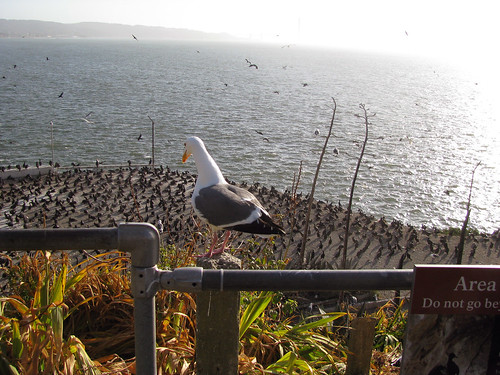
And here's a picture from last week:

Progress is clearly being made and there are nests on the ground, but they may be dummy nests. These cormorants have built them multiple times now, only to fail to lay eggs and to retreat from them at any disturbance.
Still, the cormorants are having a resurgent year. They may not yet be successfully nesting on their old colonial grounds, but they're nesting less visibly on cliffs all around the island. I don't envy the wildlife biologists in their task to count them and measure their output in such treacherous places.
Lastly, I authored a post last night on a western gull predating a snowy egret chick. I know this post has been a long one, but check that one out too, especially if you don't mind a gruesome image to go along with it.
Friday, May 28, 2010
Rehash: Alcatraz is an awful place for geese to breed
If Mike "The Situation" Sorrentino taught us anything (and he did) it's that when it comes to success in reproductive activities, it's a numbers game.

So let's review some numbers.
Pairs of geese that nest on Alcatraz at present: 10 (estimate)
Goslings typically hatched to each pair: 8
Rough total of goslings produced, based on the estimate of 10 breeding pairs: 80
Total number of goslings known and recorded to have ever fledged on Alcatraz: 0 (there is a rumor that one once fledged, but our biologist denied the existence of a record thereof)
Yes, zero. We do have one brave little gosling threatening to fledge this year and as wonderful as 'Ryan T. Gosling' aka 'Robinson Crusoe' aka 'The OMG Gosling' may be, Mike "The Situation" Sorrentino would hit us with a cocky reminder that many years of zero goslings fledged followed by one season in which they went one for eighty, is an absolute disaster, bro.

One tiny ray of light
We have an unknown number of mallards that nest on the island as well. The ducklings fail unfailingly, year on year. While a Canada goose may fledge every few years, the ducklings never do.
This afternoon, BourbonHawk took a stroll around Stow Lake in Golden Gate Park and she saw this:

It's a creche of four breeding adults and seven hopefuls. These young geese are on the five yard line to fledging rather than being gull or raven food and it has everything to do with where they are.
LadyBird, BourbonHawk and I probably encountered this same creche five weeks prior and I blogged about it here.
The long and the short of it was that we saw four adults and eight goslings going about their business when an opportunistic western gull, lured to the creche by children throwing bread, snatched up a defenseless fuzzball, leaving only seven.
As tragic a moment as that was, five weeks later there are still seven goslings likely to fledge.
In contrast, Alcatraz is a place where breeding geese apparently do not form cooperative creches, and the numbers of young geese go from this:

to this:
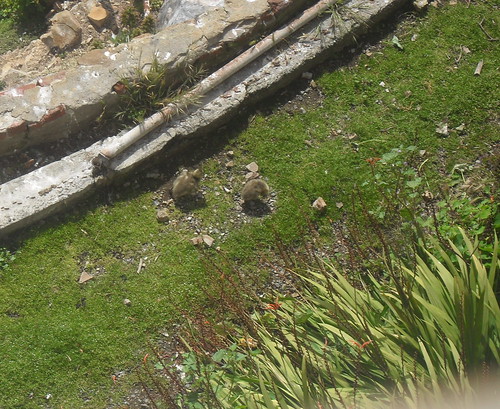
and in very short order, the last goslings are predated.
On Alcatraz, there isn't much fresh water, perhaps contributing to territorial behavior and a lack of cooperation among them as they fight over what little there is.
Between that and the efforts of our thousands of large gulls and our two enormous ravens, nary a gosling goes uneaten.
Numbers:
2010 Alcatraz Canada geese: 1 for 80. (1.25% success)
Some random Stow Lake creche: 7 for 16 (43.75% success)
C'mon, Alcatraz geese... One gosling fledged is nice but the bottom line is that we want to see fewer of you breeding on the island in 2011.
Friday, April 16, 2010
Odds, ends... (WE'RE BACK!)
Our snowy egrets have nests and they've laid eggs.
Canada goslings have hatched! While we're thrilled to behold these little balls of pure cuteness, there's really more tragedy to be had here than anything else. Canada goslings are a very popular food item on Alcatraz and the large, lumbering geese do not effectively protect their young from predation at the beaks of opportunistic gulls and ravens.
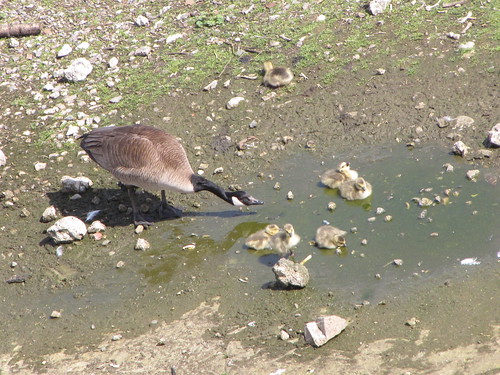
Cute while they last
A dead adult goose was found resting atop the rocky cliffs on the west side of the island.
Although we haven't seen them, the rangers tell us that there are now ducklings on the island! We'll be keeping our eyes peeled and our cameras ready.
We've been seeing many pigeon guillemots. The habits of these birds are beyond cryptic and are best left for educated experts to interpret, especially insofar as we go long stretches of time without seeing one, and then all of a sudden, wow, there's a hundred guillemots.
Arguably, the big news on the island is that the park's natural resources arm has elected to destroy most of the intricate stick nesting structures belonging to our pair of common ravens. Last Friday, the deed was done.

The only nesting structure left unharmed had freshly laid ravens' eggs inside. These eggs are soon to be oiled, a process that will prevent them from hatching.
The park service does this to benefit the other birds on the island. The ravens are deadly predators and doubly so when they have three or four extra mouths to feed. The folks at natural resources reason that taking these steps will allow a few extra black crowned night heron fledglings to survive into adulthood.
Though we're admitted amateurs, we intend to examine the raven management policies in the coming days.
These American crows had been inseparable, but recently we've been seeing just one.

Perhaps the other is incubating.
More soon to come.
 Labels:
american crow,
canada goose,
common ravens,
mallard,
pigeon guillemot,
snowy egret
|
0
comments
Labels:
american crow,
canada goose,
common ravens,
mallard,
pigeon guillemot,
snowy egret
|
0
comments
Subscribe to:
Posts (Atom)