Showing posts with label common ravens. Show all posts
Showing posts with label common ravens. Show all posts
Sunday, June 27, 2010
 Raven male defends his young; raven female is... where?

The ravens bred in 2010, but only one branchling left the nest alive. The adults watched over their young one closely and killed an adult western gull, apparently for showing a little too much interest in their pride and joy.
Then, suddenly, we went from three observable ravens to two. It seemed that the juvenile was gone. As new ravens will stay with their parents for a period of months, successful fledging and departure seemed unlikely. The speculation was of its possible demise.
As usual, the ravens had us fooled. The juvenile was still very much with us, and hiding right before our eyes. She or he vocalized softly and hoarsely while displaying submissive crouching and begging behavior typical of a juvenile or a subordinate individual in a larger group but unlikely behavior for for a breeding adult.
One mystery was solved. One of our visible ravens was the juvenile. The other was the male, discernible by its size and its trademark "fur pants" dominance display. So where is our breeding female? She's been unobserved for quite some time now.
I have a crazy hypothesis: she may be incubating a second clutch of eggs.

This would be more than unusual. It's almost unprecedented. Ravens are not double brooders, though given enough time, they will attempt another clutch if their first brood of chicks and eggs fails completely. Double brooding by ravens is so uncommon that it's only been documented in one single instance, during breeding season 2001, on the campus of UC Irvine.
My suggestion is just a hunch, but it has the following considerations in its favor:
First, there's time for a second brood. The ravens nested early this year. In the single documented case of double brooding, enough time and plentiful food resources were cited as possible factors enabling the behavior.
As for food, with a home territory like Alcatraz, with so much ecology and so much trash at hand, food wouldn't seem to be a problem.
Second, the natural resources arm of the Golden Gate National Recreation Area has visited the ravens' nest multiple times in 2010 and damage to the nest may have occurred. Just as the number of visible ravens dropped from three to two, they were observed carrying nest building materials to their tree, perhaps repairing damage their nest structures incurred. Bernd Heinrich, noted raven expert and author of the great book Mind of the Raven, observed that the ravens' cue to mate is not a ready female, but rather a finished nest.
Damaging the ravens' nesting structures may have inadvertently put them on a path towards a second clutch.

The third consideration is that while double brooding has never been documented except in the one paper I linked to, the paper's authors complain that not enough observations of this type have been attempted, especially on the divergent California clade, to which our ravens belong.
The surprising genetic differences between ravens of the American southwest and those found in all other contexts will be addressed in an upcoming post laying out what little we know about Alcatraz's raven pair.
The last consideration I'd offer in favor of the double brooding hypothesis is that Bernd Heinrich also says that if a raven minding a home territory loses its mate, he or she will find a replacement quickly, often within a day. That hasn't happened, though another plausible explanation for that might be that it's simply too late for courting and pair bonding this year, though I don't recall Heinrich indicating that this behavior is variable across the seasons.
This, combined with my gut feeling that the outright death of the female seems pretty unlikely, gives me the sense that our ravens are up to something once again.
This double brooding suggestion may be absolutely wrong and I realize that it sounds crazy. My hunches regarding birds are almost universally mistaken but if I'm right in this case, I'd like to be able to say I saw it coming.
Odds, ends:
The island loves to make a liar out of me. No sooner did I write a post entitled "A Coda on the Falcons of Alcatraz" than did the male peregrine decide to show himself on a consistent, daily basis. For now, the kid is back:

Now all he needs is a female companion to really give Alcatraz's ruling authoritarian corvidocracy a run for its money and I wouldn't miss it for the world.
Also as I disembarked onto the Alcatraz dock on Thursday, I was rendered speechless. I'd heard about ducklings on Alcatraz but neither BourbonHawk nor I had ever seen any. But there she was, a duck mother and her eight chicks, soon to be food for the predators that inhabit the island and the bay.

Sometimes words aren't good enough, so I slapped BourbonHawk on the arm and pointed them out to her, this late in the year and bobbing far too close to the machinery mounted to the rear of the boat we'd just disembarked from. We had a few jokes about these witless ducks being sucked up to their doom, but fortunately that didn't happen.
At any rate, I know they're gonners. My only hope is that they get taken by some novel predator like a seal, a porpoise or a sea lion. I'm getting a bit tired of all of this gull and raven brutality.
Here's your update on Ryan T. Gosling, the honking miracle. He's almost there. At this late date, it's a bit difficult to tell which one of the three he is, but I usually assume that the two proudest looking geese are his parents, and he's just the other one.

Brandt's cormorants! They're back indeed. Here's a picture from last year's disastrous lack of a nesting season:

And a picture from our last very good year, 2008:
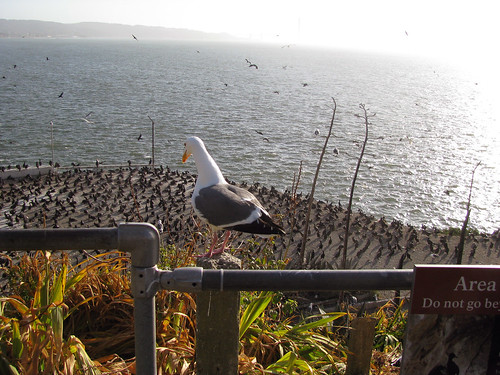
And here's a picture from last week:

Progress is clearly being made and there are nests on the ground, but they may be dummy nests. These cormorants have built them multiple times now, only to fail to lay eggs and to retreat from them at any disturbance.
Still, the cormorants are having a resurgent year. They may not yet be successfully nesting on their old colonial grounds, but they're nesting less visibly on cliffs all around the island. I don't envy the wildlife biologists in their task to count them and measure their output in such treacherous places.
Lastly, I authored a post last night on a western gull predating a snowy egret chick. I know this post has been a long one, but check that one out too, especially if you don't mind a gruesome image to go along with it.
Friday, June 4, 2010
It's a mystery!
As noted in the post below, our ravens have been acting strangely. They're always a bit enigmatic, but this year their actions have been particularly hard to decipher. A few points I wanted to bring up:

- - The image above was taken in late July of last year, and shows the first time I saw one of the fledglings actually flying outside of the nest. I observed them in the days prior to this outside of the nest, but still hesitant regarding flying. I actually have pictures of the three juveniles on the first day we were finally able to see them out of the nest, in the very top of their cypress tree, which are dated July 12th. So it seems that with Hrafn/Raven Jr. they were extremely early this year.
- - Sweep Commander observed them pulling the same trick in the gardens of pulling up the bamboo edging that I observed here in January, though obviously this could be completely unrelated behavior.
- - We haven't seen the young raven in about a week now, and as Sweep Commander noted, the ravens appear to be gathering new nesting materials. Is the young one dead? Has he left? The latter seems highly unlikely as all the information I'm aware of says that juvenile ravens stick around for 6 months after fledging.
- - Perhaps he just looks so much like an adult that we can no longer tell? I was looking at this image last night:
 and noticed the white patch on his right wing. I then watched the uber-brutal video that Sweep Commander posted below of the raven eating the WeGu chick. It looks like a similar patch of white is found on the right wing of that raven as well. Could Hrafn be hiding right under our noses? Am I totally reaching here? A steady diet of metal and mead will do that to a girl. What do you guys think?

Wednesday, June 2, 2010
Juvenile raven vanishes, breeding parents set to work on dastardly deeds, home repairs/additions
We last saw it on Sunday perched in a cypress tree eating an unknown food item. It had made an enemy of a California gull that buzzed it persistently to no effect. The most the gull could elicit from the fledgeling were a few low vocalizations.
The next day, it was gone, either fledged or dead. The bird flew well and it is now believed to have predated a western gull nest, so it appears to be more than capable of fending for itself. Also, though it was a bird in it's first year of life, it was significantly larger than the typical raven I observe on the mainland, just like mom and dad:

For size comparison's sake, the adult raven on the right and the human being on the left were equally distant from the camera as took this picture. Well... not really, but our ravens are still huge.
At any rate, though raven breeding season appears to be over, the pair is not taking a vacation. They have been actively collecting nesting materials in recent days and have been seen transporting them back to their home tree. I caught one collecting moss, presumably for nest lining.
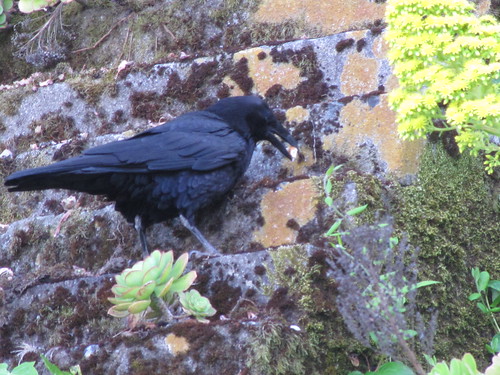
Why would the ravens be working on their nest structures? Breeding season is over. Right?
Well, the nesting structures were examined earlier in the year by our park's biologists and portions of them were tampered with or disassembled in the process. The ravens may simply be rebuilding what was destroyed.
Also, nests must be repaired each year as the hatched chicks defecate inside the nest, but it's very, very early for that process to begin. Nest construction and repair usually occurs in the spring.
A more alarming conclusion might be that these birds are making preparations to lay a second clutch. It's hard to imagine that the moss lining they're collecting could keep from year to year and ravens will sometimes lay a second or even a third smaller clutch if the first one fails, but as far as we know the ravens did successfully fledge a single bird this year and it's awfully late in the season to lay new eggs.
We'll keep watching, however, because our giant and wily ravens are not to be underestimated.
Here's a video we took today of one of them eating a gull chick. As usual, sorry for the camera shake.
Friday, April 16, 2010
Odds, ends... (WE'RE BACK!)
Our snowy egrets have nests and they've laid eggs.
Canada goslings have hatched! While we're thrilled to behold these little balls of pure cuteness, there's really more tragedy to be had here than anything else. Canada goslings are a very popular food item on Alcatraz and the large, lumbering geese do not effectively protect their young from predation at the beaks of opportunistic gulls and ravens.
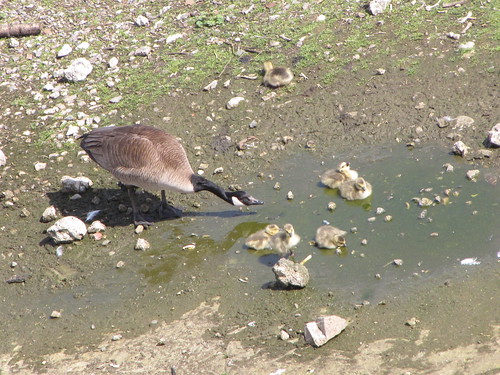
Cute while they last
A dead adult goose was found resting atop the rocky cliffs on the west side of the island.
Although we haven't seen them, the rangers tell us that there are now ducklings on the island! We'll be keeping our eyes peeled and our cameras ready.
We've been seeing many pigeon guillemots. The habits of these birds are beyond cryptic and are best left for educated experts to interpret, especially insofar as we go long stretches of time without seeing one, and then all of a sudden, wow, there's a hundred guillemots.
Arguably, the big news on the island is that the park's natural resources arm has elected to destroy most of the intricate stick nesting structures belonging to our pair of common ravens. Last Friday, the deed was done.

The only nesting structure left unharmed had freshly laid ravens' eggs inside. These eggs are soon to be oiled, a process that will prevent them from hatching.
The park service does this to benefit the other birds on the island. The ravens are deadly predators and doubly so when they have three or four extra mouths to feed. The folks at natural resources reason that taking these steps will allow a few extra black crowned night heron fledglings to survive into adulthood.
Though we're admitted amateurs, we intend to examine the raven management policies in the coming days.
These American crows had been inseparable, but recently we've been seeing just one.

Perhaps the other is incubating.
More soon to come.
 Labels:
american crow,
canada goose,
common ravens,
mallard,
pigeon guillemot,
snowy egret
|
0
comments
Labels:
american crow,
canada goose,
common ravens,
mallard,
pigeon guillemot,
snowy egret
|
0
comments
Sunday, March 14, 2010
Falcon dines again (Also: Comments Fixed!)
Now to the meat of it.

She looks happy. As usual, there are more pictures of all sizes on my flickr.
Sorry for the graininess on these photos and videos. These photos were taken utilizing a ridiculous level of optical and digital zoom. I love my camera. It's not the $3,000 body and lens setup I dream of, but somehow this combination of 80x zoom and a tripod can yield somewhat intelligible images at great distances.
It's unknown what this prey item was. Several white feathers fell from the smokestack as she ate. Several of my final images of her eating show her standing on a white feather, presumably from her quarry.
Here are a few very short videos of her dining.
I guess it wouldn't be a proper MAGANRORD post without a falcon video with semi-humorous narration.
In the following video, she finishes up and departs.
I was truly struck by just how red the meal left her beak and talons.
Also, the white feathers invite a bit of curiosity. The only prey item available that yields consistently white feathers is a gull, and our gulls are probably a little too big for her. Pigeons can be lightly plumed, so that's possible, though every feather I saw was as white as snow so I'm a little bit skeptical of that possibility. Our snowy egrets haven't returned yet, so they're ruled out.
Peregrines do scavenge and dead gulls have been turning up on Alcatraz. There were two such departed on the roof of the new industries building this afternoon.
Whatever the prey was, the female filled her crop and there were leftovers:
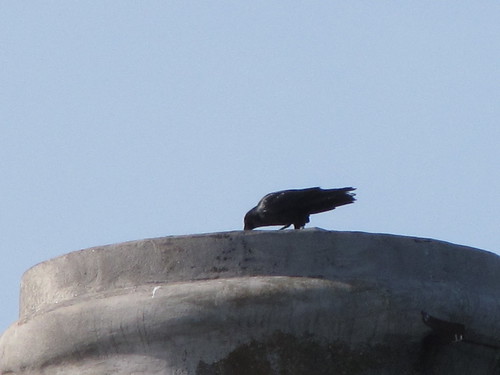
If the female abandoned her bird without finishing it, it may have been a large bird, like a gull or it may reflect her assessment of available prey. Slim pickings will mean a thoroughly devoured corpse. Abundance means she eats her preferred parts and leaves leftovers for others to scavenge.

Who says corvids and falcons can't be friends?
Also, meet this guy:
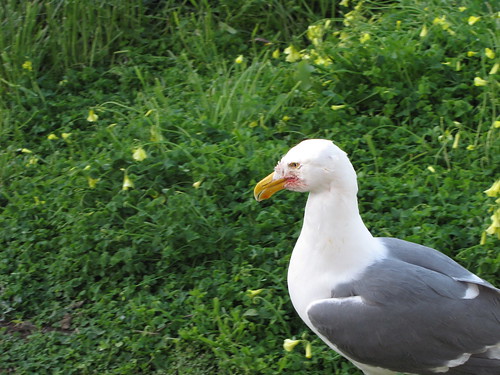
I saw him duke it out with another WEGU in a half hour brawl over what a visitor who witnessed the madness said was just a morsel of food. The whole thing made me positively squeamish and I think it led to some rather shaky camera work as I recorded the encounter.
I'm going to post our 26 minute video in the coming days. I don't expect that anyone will watch it but I do want to make a point about the gull's way of life. It's awful. It's not all mating and gloriously forcing down huge starfish. It's a lot of senseless violence. Ounces of blood and a half hour of combat leaving both gulls exhausted seems like it isn't worth a bit of chicken, which is readily available to these gulls.
Stay tuned.
Monday, March 8, 2010
Falcons? Yeah, we've got that
We fretted too soon. And then we did it again. Details and pictures to come.
The female and her boy companion had given us absolutely regular observations for months on end. Failing to observe them for a few days seemed like a good indication that they had moved on, but it might not be so.
Yesterday, we spotted the male perching on the water tower, though he disappeared before either of us could snap a picture. It was good to know Alcatraz still had a rad new apex predator to observe, even if we were hoping for a pair.
A few of the raptor experts from the Golden Gate Raptor Observatory have very generously shared their considerable knowledge and insights with us. Based on what they've told us, the falcons may both leave or our cougar female may fly north to mate, leaving her immature ally to brave Alcatraz all on his own. It may also be possible for him to mate with her just where she is. Nesting season will tell.
If she has left, it would explain why the falcons have become far less visible of late, especially as she was always much easier to observe than he was. The vast majority of Alcatraz falcon photos in the MAGANRORD archive feature her but it's been at least a week since we've seen her hopping around in her preferred cypress tree.
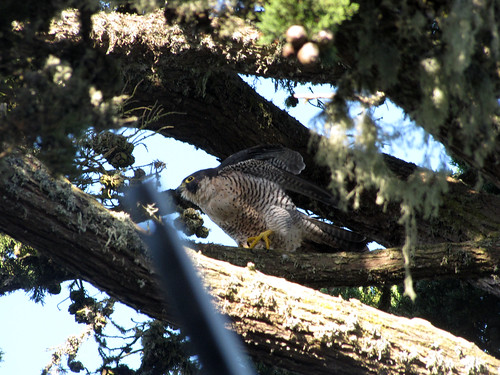
But she may not be gone yet.
Today, we had more birders from GGRO visiting us and they made some curious observations. Most importantly, they observed two falcons perching on the water tower, vocalizing to each other and then engaging in aerobatic falcon flirting, in which the male and female take to the air to dive, dart and fly in tight spirals in close proximity with each other and at great speeds.
Oddly, they reported that both birds displayed juvenile plumage. This Alcatraz falcon does not.
Now we're forced to consider a set of strange scenarios. Perhaps the adult female has moved on and a juvenile has joined him. It would explain the observations of the visiting GGRO birders and it would explain why the falcons have become so much harder to observe over the last week or so.
A less demanding explanation might just be that a trick of light or an unfortunately placed shadow interfered with the ability of our visiting birders to see the female clearly. Through the unfortunate light/shadow/haze/lack of contrast, her slate blue features may have appeared brown.
At any rate, I didn't see the female today. But I did see this guy:
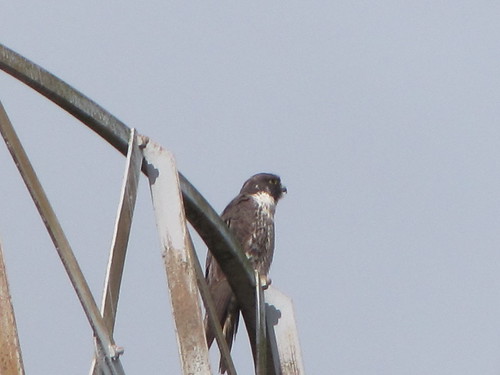
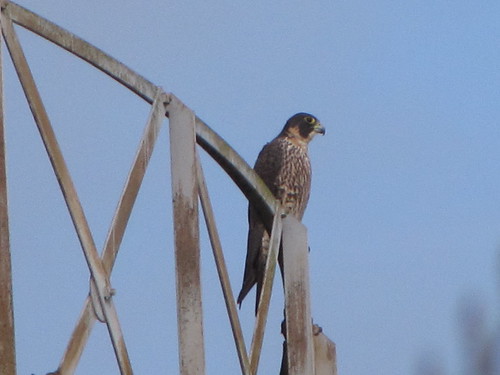
Brown. Very heavily marked chest. More pictures of him in all sizes are up on my flickr.
More investigation is required here. We'll post anything we find.
Odds, ends:
The ravens have been especially visible over the last couple of days as they soared all over the island. I saw them over and over again on every single outing.
Here's Lucky the WEGU, incurring more adult gull wrath with her begging.
She's still going strong.
Also, MAGANRORD is in clear danger of becoming a falcon blog. As such, you can expect some posts on our raven pair in the near future. We're interested in who they are, how they go about their lives on Alcatraz and we'll even be taking a quick look at the park's policy of attempting to oil (destroy) the ravens' eggs each season.
Saturday, March 6, 2010
Photos from the week:
Our Canada Geese are back in a major way. On a recent survey around the island I counted at least 10 pair. A large portion of them will surely nest on the island. These are what I can only assume are the same pair that come back to the Rec Yard every year:

Another Rec Yard resident is our "World Famous" Black Phoebe:

We have these guys all over the island, but without fail you can find this one sitting on the same perch on the fence, day after day.
On Tuesday morning, it was raining pretty steadily and on our way up the hill we encountered the male raven on a new (to us) perch:

Under the eaves of Building 64. He was croaking loudly and one can only assume trying to stay dry.
On the way down the hill at the end of the day we saw that the female had decided to join him.

Another Rec Yard resident is our "World Famous" Black Phoebe:
We have these guys all over the island, but without fail you can find this one sitting on the same perch on the fence, day after day.
On Tuesday morning, it was raining pretty steadily and on our way up the hill we encountered the male raven on a new (to us) perch:
Under the eaves of Building 64. He was croaking loudly and one can only assume trying to stay dry.
On the way down the hill at the end of the day we saw that the female had decided to join him.
Wednesday, March 3, 2010
Where did they go?
Where are our falcons?
I would very much like to see the peregrines establish themselves permanently on Alcatraz but recent observations leave me worried that any raptor pair making a home on a small island populated seasonally by two thousand western gulls faces an arduous task; I hope that our falcon pair hasn't failed already. More on that in a moment.
There is the aforementioned tendency of the gulls to take to the sky in alarm whenever the falcons soar over their roosts. In one such instance, I saw several gulls actually attacking one of the falcons in midair.
There is also a certain reckless aggression practiced by the pair and especially by the male. The ravens are certainly enemies of the gulls but they trespass on the gulls very selectively and very, very carefully. The ravens may harm the gulls by occasionally taking their eggs and young but they are deft enough to avoid being mobbed in large groups.
On the other hand, the male falcon thought that it might be wise to nearly take the head off the female raven as she was soaring by. Far from doing anything to provoke him, she seemed not to notice him until she suddenly dove to evade the attack.
On that same occasion (Monday, March 1st 3:45-4:45pm) I saw the female falcon on the railing of the water tower, stationary, apparently watching the male's antics. He would fly up, join her on her perch, hop around and then take to the sky for a few more laps of ill advised adventure.
As he aggressively darted in, around and through a cloud of angry gulls over the recreation yard and the new industries building on the west side of the island, the female only watched his maneuvers. After one energetic run, he failed to rejoin her. The gulls quieted down and their numbers in the air fell to just a few.
Ten minutes later, I spotted a dead bird on the roof of the new industries building. I reported it to our wildlife biologist and I'm at least 95% sure that it's a western gull but even with binoculars it's difficult to be sure. Tomorrow, I'll have the right hardware to make a final determination. Stay tuned.
Yesterday, in all of my outings, I saw only the female and only for a small part of the day. Today, we saw neither falcon. It's the first time in many weeks that I haven't seen either bird. They are so habit driven and preferential to the same few haunts (the water tower, the power plant, a couple of cypress trees) that it's worrisome not to have made a single sighting on any of our outings.
I know with only one falcon-free day that it's far too early to fret, but the recent conflicts with the gulls and the ravens have left me with the sad expectation that these birds won't succeed in establishing themselves. The gulls have become more numerous since the falcons arrived in November and they have become more assertive. I wouldn't be shocked if one of the falcons fell in a bloody adventure, or if they decided Alcatraz and its thousands of large gulls wasn't friendly to their reproductive prospects.
Here's to pleasant surprises of all kinds.
Odds, ends:
I got my camera back today. Expect visual media. Uh, lots.
I checked in on Lucky the WEGU today, and (s)he is alive and well, chasing adult gulls and begging for food, as is his/her pattern.
We observed a group of four crows on the island today, marauding around, soaring and executing a number of funny diving maneuvers. BourbonHawk can tell a crow from a raven at great distances and if she can't see the birds, she can tell from their calls. I, on the other hand, have some work to do.
That's it for today.
More soon.
Sunday, February 28, 2010
Our peregrine pair: Birders love them. Birds do not.
As the pair soared high over the recreation yard today, they alarmed the gulls roosting below and soon the sky was full of angry birds. The sound of their collective threat and unease vocalizations was deafening.
After perhaps fifteen minutes of falcon soaring and gull ambivalence, one falcon disappeared from view and the other descended, hovering in strong winds perhaps 40 feet above me.
Then I made our very first observation of unsolicited mobbing behavior by the gulls towards the falcons. With no clear provocation, three gulls began to pursue and attack the falcon. One managed to bite the falcon's tail several times and each time the falcon issued a vocalization that I would describe as halfway between a screech and a groan.
The falcon then evaded its three pursuers and attacked a soaring gull. Contact was made but the peregrine failed to grab or otherwise harm its target. WEGUs seem a little big for peregrine food so its possible that the attack was an expression of anger at the mob attack.
It gives us cause to wonder. In prior posts, we've speculated and even boldly predicted that the gulls would eventually drive the falcons away. We've seen the gulls handle many a red tailed hawk in this manner and when the gulls mob a raptor during nesting season, they are relentless. As nesting season comes near, will the gulls continue to lose patience with the pair of peregrines that would take Alcatraz as their own?
We'll keep you apprised.
On another note, the common raven pair was again spotted moving nesting materials to its preferred tree on the north side. The presence of the falcons there may not be enough to change their plans after all.
That's it for today.
Saturday, February 27, 2010
Fem peregrine takes a pigeon
Some very fine folks from the Golden Gate Raptor Observatory visited the island on Thursday, investigating reports of the peregrine falcon pair in our midst.
Their excursion began fruitfully enough, as they spotted the female (which I had wrongly taken to be the male) perched in her familiar cypress tree just across from the main entrance to the cellhouse basement. The male, however, was nowhere to be found.
BourbonHawk and I were able to shirk customer service duties for a bit to show the visiting birders each of the island's falcon haunts. Sadly, after forcing our guests to hike high and low around the entire island, dragging their heavy birding equipment behind them, the male failed to appear. Then, as we returned to the female falcon's perch, the male landed on the water tower, issuing forth vocalizations that our visiting birders called wailing.
The female watched the male without apparent interest.
After getting a look at the male, the experts concluded that it is a juvenile, perhaps a peale's falcon, putting Alcatraz well outside its normal breeding range. The female is a typical anatum.
Yes, you read that correctly. She's a cradle robbing cougar with a taste for the exotic! It's unknown whether or not the male will be able to breed with her, or whether the extent of their cooperation is limited to hunting and defense against the island's resident gulls and ravens.
As the clock turned to four, it was time for us to pack up and leave Alcatraz for the day. On the way down the hill, we noticed that the female had joined the male on the water tower. BourbonHawk took a picture:

Fifteen minutes later, as we boarded the boat, a small mob of gulls chased the falcon pair over the boat's boarding ramp. The female had a recently dispatched pigeon in tow. I'm not envying the island's pigeons, pigeon guillemots and starlings right now.
Here's a shot from the MAGANRORD archives.

Odds, ends:
We observed a great blue heron on Alcatraz. It had been months since we'd seen one.
Undeterred by the presence of the peregrines, the ravens defiantly carried nesting materials to their familiar tree on the north side of the island. The falcons prefer the north side and that may be why the ravens now spend considerably less time there.
Subscribe to:
Posts (Atom)