Showing posts with label peregrine falcon. Show all posts
Showing posts with label peregrine falcon. Show all posts
Sunday, June 27, 2010
 Raven male defends his young; raven female is... where?

The ravens bred in 2010, but only one branchling left the nest alive. The adults watched over their young one closely and killed an adult western gull, apparently for showing a little too much interest in their pride and joy.
Then, suddenly, we went from three observable ravens to two. It seemed that the juvenile was gone. As new ravens will stay with their parents for a period of months, successful fledging and departure seemed unlikely. The speculation was of its possible demise.
As usual, the ravens had us fooled. The juvenile was still very much with us, and hiding right before our eyes. She or he vocalized softly and hoarsely while displaying submissive crouching and begging behavior typical of a juvenile or a subordinate individual in a larger group but unlikely behavior for for a breeding adult.
One mystery was solved. One of our visible ravens was the juvenile. The other was the male, discernible by its size and its trademark "fur pants" dominance display. So where is our breeding female? She's been unobserved for quite some time now.
I have a crazy hypothesis: she may be incubating a second clutch of eggs.

This would be more than unusual. It's almost unprecedented. Ravens are not double brooders, though given enough time, they will attempt another clutch if their first brood of chicks and eggs fails completely. Double brooding by ravens is so uncommon that it's only been documented in one single instance, during breeding season 2001, on the campus of UC Irvine.
My suggestion is just a hunch, but it has the following considerations in its favor:
First, there's time for a second brood. The ravens nested early this year. In the single documented case of double brooding, enough time and plentiful food resources were cited as possible factors enabling the behavior.
As for food, with a home territory like Alcatraz, with so much ecology and so much trash at hand, food wouldn't seem to be a problem.
Second, the natural resources arm of the Golden Gate National Recreation Area has visited the ravens' nest multiple times in 2010 and damage to the nest may have occurred. Just as the number of visible ravens dropped from three to two, they were observed carrying nest building materials to their tree, perhaps repairing damage their nest structures incurred. Bernd Heinrich, noted raven expert and author of the great book Mind of the Raven, observed that the ravens' cue to mate is not a ready female, but rather a finished nest.
Damaging the ravens' nesting structures may have inadvertently put them on a path towards a second clutch.

The third consideration is that while double brooding has never been documented except in the one paper I linked to, the paper's authors complain that not enough observations of this type have been attempted, especially on the divergent California clade, to which our ravens belong.
The surprising genetic differences between ravens of the American southwest and those found in all other contexts will be addressed in an upcoming post laying out what little we know about Alcatraz's raven pair.
The last consideration I'd offer in favor of the double brooding hypothesis is that Bernd Heinrich also says that if a raven minding a home territory loses its mate, he or she will find a replacement quickly, often within a day. That hasn't happened, though another plausible explanation for that might be that it's simply too late for courting and pair bonding this year, though I don't recall Heinrich indicating that this behavior is variable across the seasons.
This, combined with my gut feeling that the outright death of the female seems pretty unlikely, gives me the sense that our ravens are up to something once again.
This double brooding suggestion may be absolutely wrong and I realize that it sounds crazy. My hunches regarding birds are almost universally mistaken but if I'm right in this case, I'd like to be able to say I saw it coming.
Odds, ends:
The island loves to make a liar out of me. No sooner did I write a post entitled "A Coda on the Falcons of Alcatraz" than did the male peregrine decide to show himself on a consistent, daily basis. For now, the kid is back:

Now all he needs is a female companion to really give Alcatraz's ruling authoritarian corvidocracy a run for its money and I wouldn't miss it for the world.
Also as I disembarked onto the Alcatraz dock on Thursday, I was rendered speechless. I'd heard about ducklings on Alcatraz but neither BourbonHawk nor I had ever seen any. But there she was, a duck mother and her eight chicks, soon to be food for the predators that inhabit the island and the bay.

Sometimes words aren't good enough, so I slapped BourbonHawk on the arm and pointed them out to her, this late in the year and bobbing far too close to the machinery mounted to the rear of the boat we'd just disembarked from. We had a few jokes about these witless ducks being sucked up to their doom, but fortunately that didn't happen.
At any rate, I know they're gonners. My only hope is that they get taken by some novel predator like a seal, a porpoise or a sea lion. I'm getting a bit tired of all of this gull and raven brutality.
Here's your update on Ryan T. Gosling, the honking miracle. He's almost there. At this late date, it's a bit difficult to tell which one of the three he is, but I usually assume that the two proudest looking geese are his parents, and he's just the other one.

Brandt's cormorants! They're back indeed. Here's a picture from last year's disastrous lack of a nesting season:

And a picture from our last very good year, 2008:
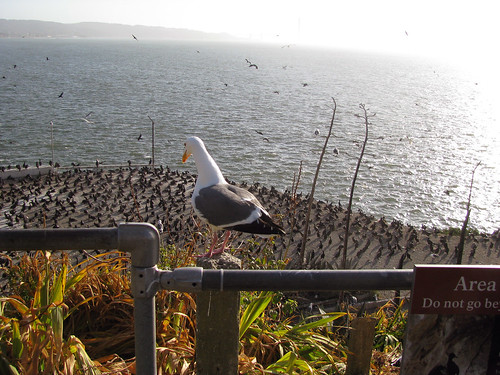
And here's a picture from last week:

Progress is clearly being made and there are nests on the ground, but they may be dummy nests. These cormorants have built them multiple times now, only to fail to lay eggs and to retreat from them at any disturbance.
Still, the cormorants are having a resurgent year. They may not yet be successfully nesting on their old colonial grounds, but they're nesting less visibly on cliffs all around the island. I don't envy the wildlife biologists in their task to count them and measure their output in such treacherous places.
Lastly, I authored a post last night on a western gull predating a snowy egret chick. I know this post has been a long one, but check that one out too, especially if you don't mind a gruesome image to go along with it.
 Labels:
Monday, May 31, 2010
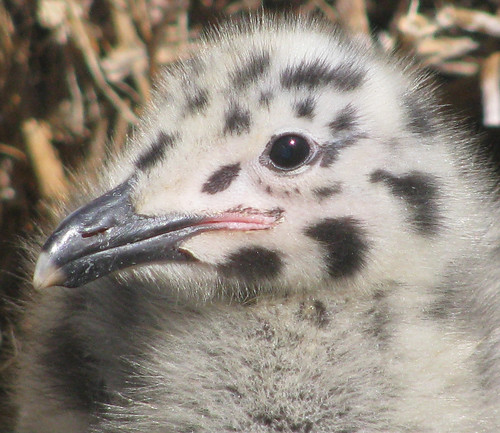
Alcatraz has babies! Cuteness overload!
The visitor to Alcatraz wants his Al Capone, his "Machine Gun" Kelly and his "Birdman" Stroud. She wants to tour our rows of tiny cells, to see the narrow cots, the lead paint peeling off of crumbling walls and to hear the loud sounds of cell doors slamming, all behind a curtain of dense San Francisco fog. And we'll give them that.
But not before they find themselves surrounded by these speckled grey balls of pure fuzz and cuteness. Every year around this time, Alcatraz becomes an avian nursery nurturing around five percent of the world's baby WEGUs.
You'll be slain when confronted with three thousand of these. The following pictures are from summers past.
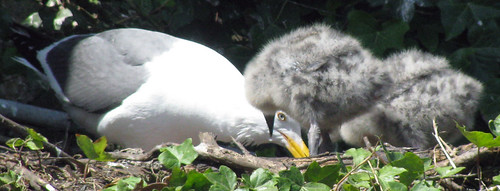
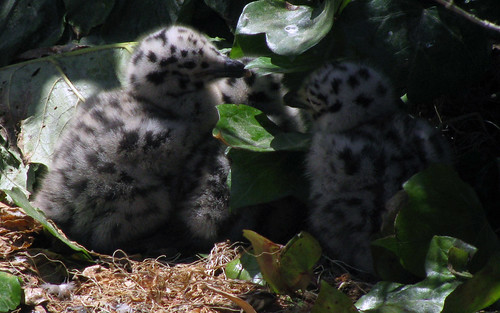
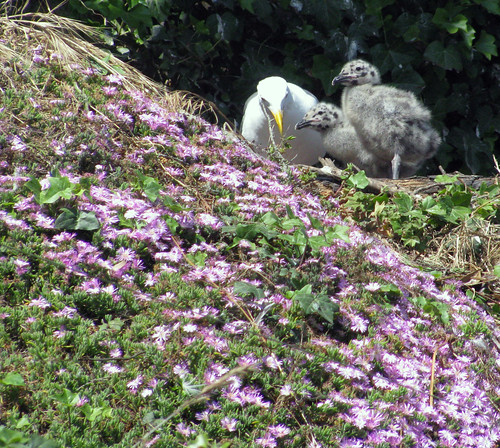
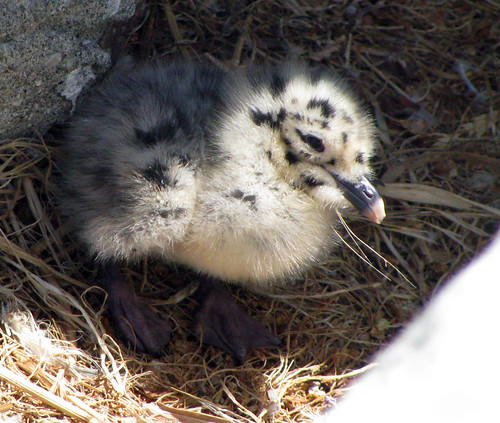
Nowhere else can you buy a ticket for a reasonable price, take a twelve minute ferry ride and experience this. Our baby WEGUs are beginning to hatch!
These were the first hatchlings we saw:

Pardon the graininess. This gull family lives deep in the parade ground area, which is closed for nesting season. As more chicks hatch, we'll have many more photos for you.
Unfortunately, it's our duty as a metal-themed bird blog to bring you br00tality as well. We don't enjoy doing it, but the bitter fact is that these balls of fluff often die at their cutest. One of the first clutches hatched yesterday and each chick promptly died. Amazingly, out of the thousand nests on the island, this was the one featured in our recent post entitled "Now we wait..." I wonder whether I've cursed this gull family. One individual:

But there is optimism to be had. Each nesting season we have our favorites that we root for and many of them go on to fledge successfully.
Speaking of babies...
Well, no one thinks of our fierce little peregrine tiercel as a baby but the little guy still hasn't donned his adult plumage. The books say we can expect him to turn from brown to blue after the breeding season. If he decides to stay and he survives through to winter, we'll have a better idea of where he falls among the three North American subspecies of the peregrine falcon. It's been suggested that he's a Peale's falcon, a coastal, northwestern variety that is the biggest and darkest of the three, and the largest subspecies of peregrine in the world. Our little guy may be a little small for all of that.
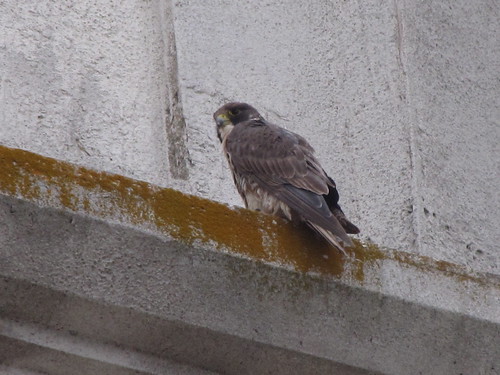
One concern with our peregrine is that while we still spot him regularly, the frequency of observation has declined considerably and now your only shot to observe him is to carefully scan the lighthouse. When his crop is full and he's feeling sedentary, he can be found on the upper ledges.
Ryan T. Gosling! Baby goose!
If there were an Intrade contract that Ryan would fledge, it would be trading at 95 cents for a dollar payout at this point. This guy/gal is money in the bank:

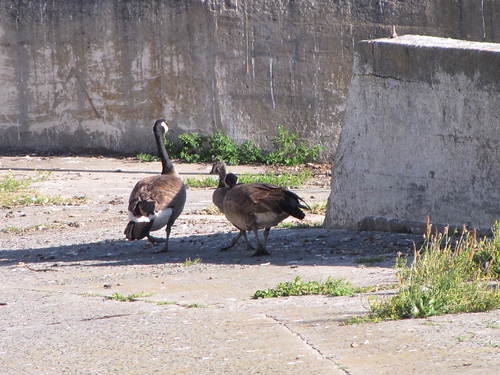


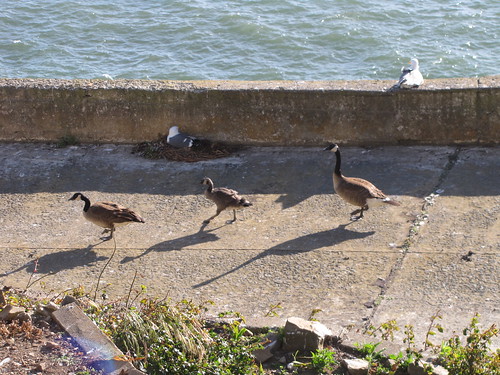
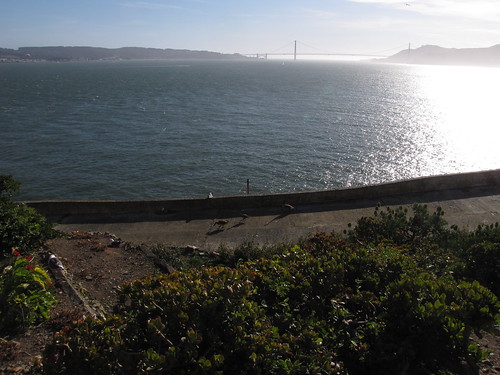
While we've been very critical of the geese that nest on Alcatraz, it's been a true privilege to watch this little guy at every stage of his development, from a cute but anonymous tiny ball of fuzzy green confetti, to a little yellow football-sized creature trying to make its way in the world. Now he's going on to be a real goose, quickly growing into his adult plumage. Where does the time go?
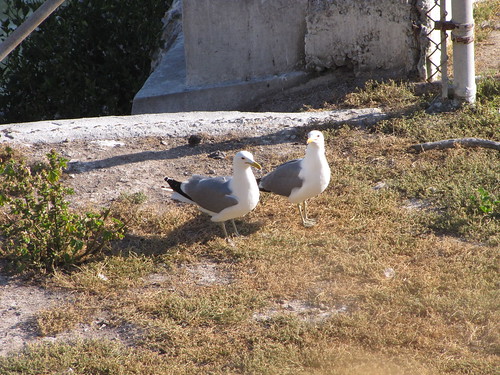
One more thing: Maganrord has one thing to say to the following pair of California gulls that has been seen near the old prison incinerator: Nest, or get off the spot! We're tired of seeing you hanging around doing nothing! We want to see some CAGU chicks.
Wednesday, March 24, 2010
Tiercel still around, cryptic, gleefully terrorizing the WEGUs
Our tiercel has become very secretive, but when he is visible, he's having a great time.
He goes about life doing exactly what I might were I given an hour in a falcon's body. Our bird passes the time by messing with gulls in extravagant aerial combat.
We observed him doing so yesterday around 6 pm near the dock.
On a more boring note, I've finally begun to identify which subspecies of Canada goose are present on the island. So far, it's just the 'common' variety. Booooring. I have seen one pair of smaller geese on the island. I'm hoping to have pictures of those up soon, hopefully with an identification.
Sunday, March 14, 2010
Falcon dines again (Also: Comments Fixed!)
Now to the meat of it.

She looks happy. As usual, there are more pictures of all sizes on my flickr.
Sorry for the graininess on these photos and videos. These photos were taken utilizing a ridiculous level of optical and digital zoom. I love my camera. It's not the $3,000 body and lens setup I dream of, but somehow this combination of 80x zoom and a tripod can yield somewhat intelligible images at great distances.
It's unknown what this prey item was. Several white feathers fell from the smokestack as she ate. Several of my final images of her eating show her standing on a white feather, presumably from her quarry.
Here are a few very short videos of her dining.
I guess it wouldn't be a proper MAGANRORD post without a falcon video with semi-humorous narration.
In the following video, she finishes up and departs.
I was truly struck by just how red the meal left her beak and talons.
Also, the white feathers invite a bit of curiosity. The only prey item available that yields consistently white feathers is a gull, and our gulls are probably a little too big for her. Pigeons can be lightly plumed, so that's possible, though every feather I saw was as white as snow so I'm a little bit skeptical of that possibility. Our snowy egrets haven't returned yet, so they're ruled out.
Peregrines do scavenge and dead gulls have been turning up on Alcatraz. There were two such departed on the roof of the new industries building this afternoon.
Whatever the prey was, the female filled her crop and there were leftovers:
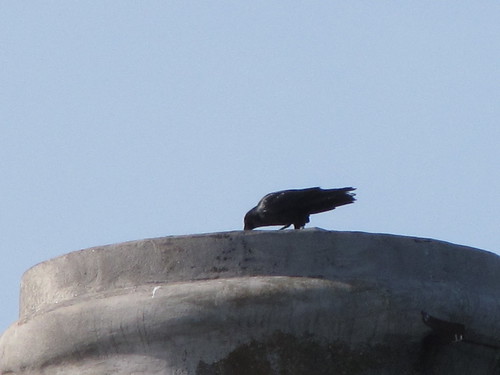
If the female abandoned her bird without finishing it, it may have been a large bird, like a gull or it may reflect her assessment of available prey. Slim pickings will mean a thoroughly devoured corpse. Abundance means she eats her preferred parts and leaves leftovers for others to scavenge.

Who says corvids and falcons can't be friends?
Also, meet this guy:
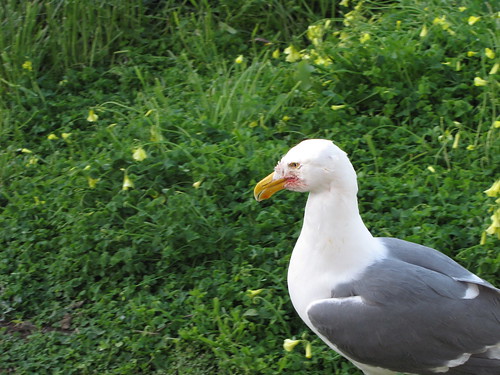
I saw him duke it out with another WEGU in a half hour brawl over what a visitor who witnessed the madness said was just a morsel of food. The whole thing made me positively squeamish and I think it led to some rather shaky camera work as I recorded the encounter.
I'm going to post our 26 minute video in the coming days. I don't expect that anyone will watch it but I do want to make a point about the gull's way of life. It's awful. It's not all mating and gloriously forcing down huge starfish. It's a lot of senseless violence. Ounces of blood and a half hour of combat leaving both gulls exhausted seems like it isn't worth a bit of chicken, which is readily available to these gulls.
Stay tuned.
Wednesday, March 10, 2010
Could Alcatraz have three peregrine falcons!?!
If the last seven months of falcon watching have taught me anything, it's that I'm an amateur. I can record digital images, think, read stacks of books and write for days, but the fact is that we at MAGANRORD are new to this.
With that level of humility in mind, I want put forward the possibility that there might be at least three peregrine falcons visiting or residing on Alcatraz. Two would be juvenile. One is mature.
All pictures and video included/linked to were recorded between Monday, March 8 and Wednesday March 10. For more views of each of these three potentially distinct birds, please click on the links I provided. Sorry about the timestamps indicating the images were taken in early January 2008. As it turns out, the Canon repair facility can't fix your jammed optical assembly without resetting your camera's internal clock.
From here on out, I'll keep it pithy.
Bird one:
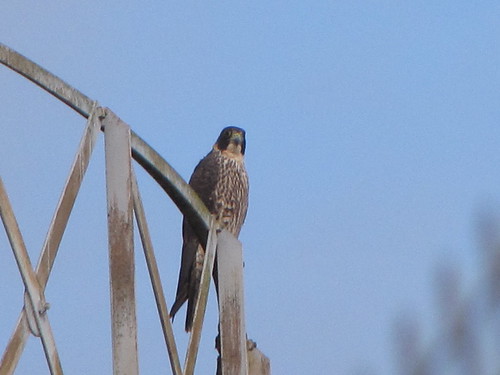
Note the dark brown, the shape of the helmet, heavy and unbroken breast streaking.
Click here for more pics of this bird and write back with your thoughts on this one. Is this a female?
Bird two:
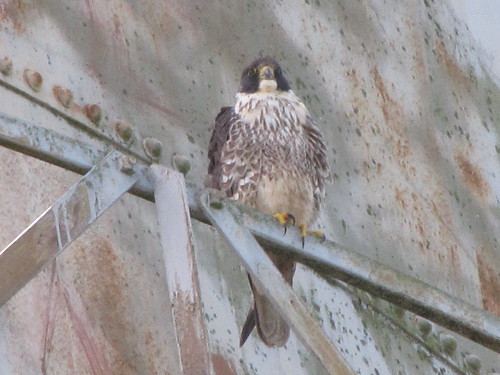
Note white patches on each breast, which far from being a trick of the wind or the angle were observed on back to back days on different outings. Also, the shape of the helmet, the size of the beak in relation to the size of the body.
Bird three:
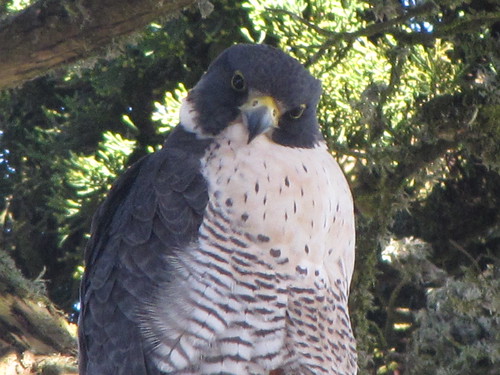
Since November, we've been observing her the most. Before today, we hadn't spotted this individual in a week. We'd figured she'd left us to participate in seasonal raptor migration. We're glad to know she's still around.
Note mature features (slate/blue plumage, very lightly marked upper breast).
More pictures of her here. There are still more pictures of this individual in MAGANRORD's back posts.
As a bonus, here's video taken by BourbonHawk and I of our familiar adult female chilaxing in her favorite cypress tree:
Monday, March 8, 2010
Falcons? Yeah, we've got that
We fretted too soon. And then we did it again. Details and pictures to come.
The female and her boy companion had given us absolutely regular observations for months on end. Failing to observe them for a few days seemed like a good indication that they had moved on, but it might not be so.
Yesterday, we spotted the male perching on the water tower, though he disappeared before either of us could snap a picture. It was good to know Alcatraz still had a rad new apex predator to observe, even if we were hoping for a pair.
A few of the raptor experts from the Golden Gate Raptor Observatory have very generously shared their considerable knowledge and insights with us. Based on what they've told us, the falcons may both leave or our cougar female may fly north to mate, leaving her immature ally to brave Alcatraz all on his own. It may also be possible for him to mate with her just where she is. Nesting season will tell.
If she has left, it would explain why the falcons have become far less visible of late, especially as she was always much easier to observe than he was. The vast majority of Alcatraz falcon photos in the MAGANRORD archive feature her but it's been at least a week since we've seen her hopping around in her preferred cypress tree.
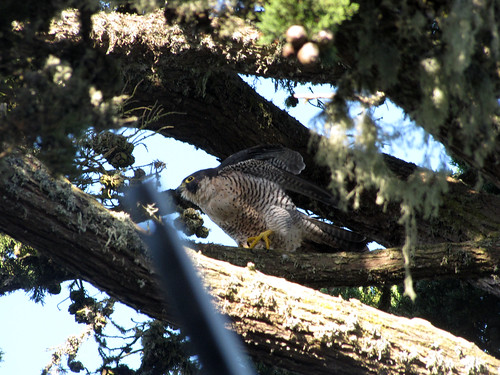
But she may not be gone yet.
Today, we had more birders from GGRO visiting us and they made some curious observations. Most importantly, they observed two falcons perching on the water tower, vocalizing to each other and then engaging in aerobatic falcon flirting, in which the male and female take to the air to dive, dart and fly in tight spirals in close proximity with each other and at great speeds.
Oddly, they reported that both birds displayed juvenile plumage. This Alcatraz falcon does not.
Now we're forced to consider a set of strange scenarios. Perhaps the adult female has moved on and a juvenile has joined him. It would explain the observations of the visiting GGRO birders and it would explain why the falcons have become so much harder to observe over the last week or so.
A less demanding explanation might just be that a trick of light or an unfortunately placed shadow interfered with the ability of our visiting birders to see the female clearly. Through the unfortunate light/shadow/haze/lack of contrast, her slate blue features may have appeared brown.
At any rate, I didn't see the female today. But I did see this guy:
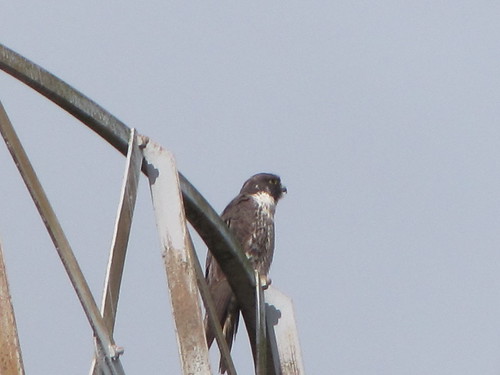
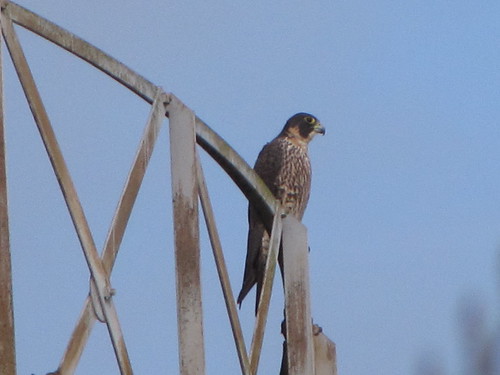
Brown. Very heavily marked chest. More pictures of him in all sizes are up on my flickr.
More investigation is required here. We'll post anything we find.
Odds, ends:
The ravens have been especially visible over the last couple of days as they soared all over the island. I saw them over and over again on every single outing.
Here's Lucky the WEGU, incurring more adult gull wrath with her begging.
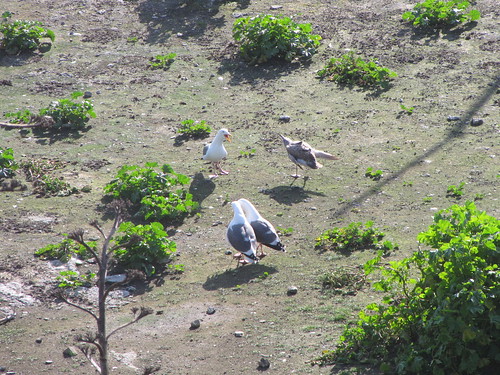
She's still going strong.
Also, MAGANRORD is in clear danger of becoming a falcon blog. As such, you can expect some posts on our raven pair in the near future. We're interested in who they are, how they go about their lives on Alcatraz and we'll even be taking a quick look at the park's policy of attempting to oil (destroy) the ravens' eggs each season.
Friday, March 5, 2010
Dead bird update
Update:
BourbonHawk: And here's a picture:

Thursday, March 4, 2010
Two days without falcons
the header says it all.
Oh, and we saw a few gulls harassing a pair of great blue herons near the dock.
Wednesday, March 3, 2010
Where did they go?
Where are our falcons?
I would very much like to see the peregrines establish themselves permanently on Alcatraz but recent observations leave me worried that any raptor pair making a home on a small island populated seasonally by two thousand western gulls faces an arduous task; I hope that our falcon pair hasn't failed already. More on that in a moment.
There is the aforementioned tendency of the gulls to take to the sky in alarm whenever the falcons soar over their roosts. In one such instance, I saw several gulls actually attacking one of the falcons in midair.
There is also a certain reckless aggression practiced by the pair and especially by the male. The ravens are certainly enemies of the gulls but they trespass on the gulls very selectively and very, very carefully. The ravens may harm the gulls by occasionally taking their eggs and young but they are deft enough to avoid being mobbed in large groups.
On the other hand, the male falcon thought that it might be wise to nearly take the head off the female raven as she was soaring by. Far from doing anything to provoke him, she seemed not to notice him until she suddenly dove to evade the attack.
On that same occasion (Monday, March 1st 3:45-4:45pm) I saw the female falcon on the railing of the water tower, stationary, apparently watching the male's antics. He would fly up, join her on her perch, hop around and then take to the sky for a few more laps of ill advised adventure.
As he aggressively darted in, around and through a cloud of angry gulls over the recreation yard and the new industries building on the west side of the island, the female only watched his maneuvers. After one energetic run, he failed to rejoin her. The gulls quieted down and their numbers in the air fell to just a few.
Ten minutes later, I spotted a dead bird on the roof of the new industries building. I reported it to our wildlife biologist and I'm at least 95% sure that it's a western gull but even with binoculars it's difficult to be sure. Tomorrow, I'll have the right hardware to make a final determination. Stay tuned.
Yesterday, in all of my outings, I saw only the female and only for a small part of the day. Today, we saw neither falcon. It's the first time in many weeks that I haven't seen either bird. They are so habit driven and preferential to the same few haunts (the water tower, the power plant, a couple of cypress trees) that it's worrisome not to have made a single sighting on any of our outings.
I know with only one falcon-free day that it's far too early to fret, but the recent conflicts with the gulls and the ravens have left me with the sad expectation that these birds won't succeed in establishing themselves. The gulls have become more numerous since the falcons arrived in November and they have become more assertive. I wouldn't be shocked if one of the falcons fell in a bloody adventure, or if they decided Alcatraz and its thousands of large gulls wasn't friendly to their reproductive prospects.
Here's to pleasant surprises of all kinds.
Odds, ends:
I got my camera back today. Expect visual media. Uh, lots.
I checked in on Lucky the WEGU today, and (s)he is alive and well, chasing adult gulls and begging for food, as is his/her pattern.
We observed a group of four crows on the island today, marauding around, soaring and executing a number of funny diving maneuvers. BourbonHawk can tell a crow from a raven at great distances and if she can't see the birds, she can tell from their calls. I, on the other hand, have some work to do.
That's it for today.
More soon.
Sunday, February 28, 2010
Our peregrine pair: Birders love them. Birds do not.
As the pair soared high over the recreation yard today, they alarmed the gulls roosting below and soon the sky was full of angry birds. The sound of their collective threat and unease vocalizations was deafening.
After perhaps fifteen minutes of falcon soaring and gull ambivalence, one falcon disappeared from view and the other descended, hovering in strong winds perhaps 40 feet above me.
Then I made our very first observation of unsolicited mobbing behavior by the gulls towards the falcons. With no clear provocation, three gulls began to pursue and attack the falcon. One managed to bite the falcon's tail several times and each time the falcon issued a vocalization that I would describe as halfway between a screech and a groan.
The falcon then evaded its three pursuers and attacked a soaring gull. Contact was made but the peregrine failed to grab or otherwise harm its target. WEGUs seem a little big for peregrine food so its possible that the attack was an expression of anger at the mob attack.
It gives us cause to wonder. In prior posts, we've speculated and even boldly predicted that the gulls would eventually drive the falcons away. We've seen the gulls handle many a red tailed hawk in this manner and when the gulls mob a raptor during nesting season, they are relentless. As nesting season comes near, will the gulls continue to lose patience with the pair of peregrines that would take Alcatraz as their own?
We'll keep you apprised.
On another note, the common raven pair was again spotted moving nesting materials to its preferred tree on the north side. The presence of the falcons there may not be enough to change their plans after all.
That's it for today.
Saturday, February 27, 2010
Fem peregrine takes a pigeon
Some very fine folks from the Golden Gate Raptor Observatory visited the island on Thursday, investigating reports of the peregrine falcon pair in our midst.
Their excursion began fruitfully enough, as they spotted the female (which I had wrongly taken to be the male) perched in her familiar cypress tree just across from the main entrance to the cellhouse basement. The male, however, was nowhere to be found.
BourbonHawk and I were able to shirk customer service duties for a bit to show the visiting birders each of the island's falcon haunts. Sadly, after forcing our guests to hike high and low around the entire island, dragging their heavy birding equipment behind them, the male failed to appear. Then, as we returned to the female falcon's perch, the male landed on the water tower, issuing forth vocalizations that our visiting birders called wailing.
The female watched the male without apparent interest.
After getting a look at the male, the experts concluded that it is a juvenile, perhaps a peale's falcon, putting Alcatraz well outside its normal breeding range. The female is a typical anatum.
Yes, you read that correctly. She's a cradle robbing cougar with a taste for the exotic! It's unknown whether or not the male will be able to breed with her, or whether the extent of their cooperation is limited to hunting and defense against the island's resident gulls and ravens.
As the clock turned to four, it was time for us to pack up and leave Alcatraz for the day. On the way down the hill, we noticed that the female had joined the male on the water tower. BourbonHawk took a picture:

Fifteen minutes later, as we boarded the boat, a small mob of gulls chased the falcon pair over the boat's boarding ramp. The female had a recently dispatched pigeon in tow. I'm not envying the island's pigeons, pigeon guillemots and starlings right now.
Here's a shot from the MAGANRORD archives.

Odds, ends:
We observed a great blue heron on Alcatraz. It had been months since we'd seen one.
Undeterred by the presence of the peregrines, the ravens defiantly carried nesting materials to their familiar tree on the north side of the island. The falcons prefer the north side and that may be why the ravens now spend considerably less time there.
Monday, February 22, 2010
Falcon News and Lucky the WEGU!
'WEGU' is bird nerd speak for western gull.
Here's your Alactraz birding update:
- For a number of weeks now, an injured juvenile western gull has been living on the west side of the island, hobbling about near the old prison incinerator. When I first observed the individual, I thought he or she would surely starve or be killed by an angry adult, tired of the endless begging for food. Somehow the bird has endured and because of this very good fortune displayed the enfeebled gull, I've decided to name it 'Lucky'.
- Fellow western gulls respond to Lucky in the same way that the typical city dweller responds to a homeless person aggressively trying to hock copies of The Street Spirit. As he/she whines hoarsely and desperately pecks at their lower mandibles in an attempt to force them to regurgitate food, the mature birds shift their gaze, looking to the side or at the soil as they go about their business or walk fleetly away. They avoid looking Lucky in the eye as they evade or ignore.
- Curiously, the other western gulls almost never show an interest in harming Lucky. Once, I did see a gull try to deter Lucky's begging with violence, but another adult gull intervened, apparently to help the poor WEGU. I don't know whether the gull who intervened to aid Lucky was of any relation to him or her, but on the whole it struck me as a strange behavior for any western gull to display. These are not compassionate creatures.

- Several pairs of mallards have arrived on the island and from our observations over the last several days, these are some very sleepy ducks.
- The male falcon could be seen darting, diving and weaving inside a hostile mob of western gulls at around 4:30 this afternoon. Eventually it squirmed away and perched on the lighthouse.
- The female falcon has adopted a fairly predictable daily routine. More mornings than not, she perches on the water tower's railings facing west. When afternoon comes around, she moves to the other side and faces east. This may indicate a preference to face away from the sun, perhaps because direct sunlight interferes with her ability to perceive her surroundings or assess her prey.

Click on the image for a larger size
- After speaking with a number of former Alcatraz bird biologists, I've learned that falcons have been spotted on the island with regularity going back to the early 2000s, and perhaps earlier. As far as I can tell, however, it was assumed that any sighting was of an individual belonging to a known and established local pair, such as the pair that nest on the bay bridge. This year is unique because we've observed that we do indeed have a pair and we've seen them with enough brute regularity to surmise that they spend the vast majority of their time on Alcatraz.

Click on the image for a larger size
- I saw the pair flying together recently in high wind, performing yet more joint aerial acrobatics, spinning circles around each other, dive bombing one another and just doing a whole lot of what I'm assuming was falcon flirting. When one falcon disappeared, the other soared over a pair of gulls and aggressively fell towards one with talons extended. Gulls are not the fools of the sky, however, and this one simply executed an evasive falling maneuver of its own. The falcon then proceeded to approach the other gull in the same way with the same result.
- An adult western gull is probably a bit big for a peregrine to make a serious attempt to predate it. Rather, the falcon was probably feeling a bit feisty from all the courtship and hey, you've gotta direct that energy somewhere.
- Two western gulls aggressively chased a brown pelican over Alcatraz today, perhaps in an attempt to force it to give up its catch of fish. This behavior is called kleptoparasitism.
- Mourning doves and American crows have been spotted on the island in the last week.
That's it for today.
Monday, February 1, 2010
Midweek Mystery Meal
One morning last week, ol' Sweep Commander and I approached Alcatraz's amazing National Park Service site supervisor, asking for her blessing in exploring some of the closed areas on the west side of the island. Initially we wanted only to scope out an area near the New Industries Building where a former Alcatraz wildlife biologist said that Heermann's gulls could sometimes be seen by the dozen. The search for exotic gulls proved fruitless, as there was nary an orange-beaked little gull to be found. There were no gulls in the area at all, for that matter.
However, we stumbled upon far too much radness to be disappointed. I saw my first black oystercatcher, we found numerous desiccated corpses from the 2008 cormorant colony (post coming soon), and MOST AWESOMELY:
However, we stumbled upon far too much radness to be disappointed. I saw my first black oystercatcher, we found numerous desiccated corpses from the 2008 cormorant colony (post coming soon), and MOST AWESOMELY:

We found the falcon with a fresh kill!
We're still working on figuring out what exactly it is that she killed, but this was incredibly exciting to both of us as we had yet to see her feeding. Even better, we've got it on video!
That's some National Geographic stuff right there.
Sidenote: If any of our lovely and knowledgeable readers out there have an idea of what our feisty falcon was feasting on, please feel free to share! Larger copies of the image can be found here.
Friday, January 29, 2010
Island's western gull males remind desirious females that Valentine's Day is a ways off
Thinking I might have the opportunity to document some early mating, I recorded this female, the smaller gull on the left, trying to entice her male. She positioned herself with her back to her partner and began the upward movement of the head seen in the video, along with the vocalization that accompanies it.This is how one western gull tells another that he or she wants food or sex.
However, just as I hit the record button, the male gull violently denied her, giving her instead a stern bite to the neck. This occurs in the video's opening moment.
We observed similar interactions among other western gull pairs, albeit without the violence.
Odds and ends
- Canada geese have arrived on Alcatraz. We can't be everywhere on the island at once, but our sense now that we're hosting around eight or so. The canada goose is divided into several subspecies and one of the next items on our amateur bird detective agenda is to find out what subspecies our geese belong to.

- The pigeon guillemots have also returned, seemingly going from invisible and absent to ubiquitous and loud in about a week.
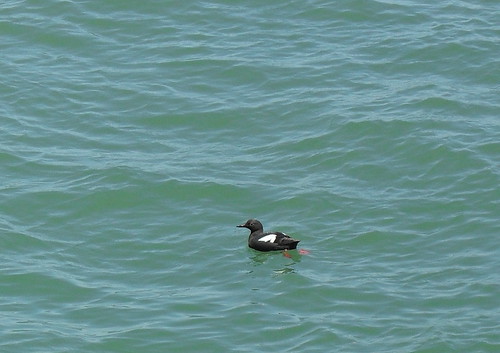
- Brown pelicans now fly over the island with regularity. As recently as a year ago, pelicans not sick or injured avoided Alcatraz as if it were the center of evil and dishonor in the bird universe. While this isn't exactly a sensational observation, it's no less baffling for that. What has changed?
- Numerous brandt's cormorants have been seen on Alcatraz and in the waters around it. We can't wait to see if they return to breed.
- The common raven pair has been far less visible over the last week or two.
- The falcon had a bloody adventure recently. Stay tuned to MAGANRORD for BourbonHawk's upcoming post. Here's a little taste:

I wonder what she has there.
Sunday, January 17, 2010
PEREGRINE FALCON GALLERY

FALCON: hey bro, I'mma get you back for that whole pesticide falcon genocide thing... but for now I want to show you my pictures from one of the greatest winter vacations of all time!
behold the falcon's aforementioned raditude...
DEATH FROM ABOVE

While summer nesting season on Alcatraz is a bonanza for bird nerds, here is one reason why winter season can be just as rewarding for those tickled by bird life and behavior.
On November 22, 2009, fellow Maganrord blogger BourbonHawk, National Park Service Ranger John Cantwell and I got our first glimpse of the peregrine falcon now making itself at home in the tops of the island's cypress and eucalyptus trees, the water tower, the top of the power plant's smoke stack, and the shoots of agave adjacent to the west road and parade ground. A careful survey of these areas will give you a better than even chance of spotting it.
This peregrine is about the size of a seagull or a raven and is thus a probable female, though this is a difficult determination to make. Male and female falcons display what wildlife biologists like to call "reverse sexual dimorphism" – a term that is so ill conceived I'm embarrassed to even use it. In the zoology biz it means that males of the species are generally smaller than females. Regular old "sexual dimorphism" is present in species where males are larger. (C'mon, wildlife biologists. This is silly. Having smaller males than females is just the other kind of sexual dimorphism. Don't make me tell you your business!)
She is a formidable and sharply observant hunter. When a peckish peregrine notices a small or medium sized bird flying below, her wings fold in and the barrel of her body tips down towards the earth as she begins to dive. A peregrine dive was once clocked at 242 miles per hour, the fastest known speed to be reached by any animal under its own power. For the falcon, a successful dive yields an instantaneous kill.
It's a good bet that she's taken a few pigeons and starlings off our hands.
Worldwide, the peregrine lives and breeds on six continents and has around 20 recognized subspecies. Our falcon is a probably a member of the North American variety, Falco peregrinus anatum. 'Anatum', being latin for "duck eater", references the the bird's love of duck meat. For the same reason, the North American peregrine was once also known as the duck hawk.

Even given its record setting aeronautical feats, what's remarkable about this falcon is its survival story. The first half of the 20th century was as gloomy for the peregine as it was on Alcatraz. Though a fearsome bird, anatum proved defenseless against the scourge of the pesticide DDT. Widely used in American agriculture from the 1940s through its eventual ban in 1972, DDT's effects upon birds were as brOOtal as any metal front man's growl. The pesticide thinned anatum's eggshells and the embryos enclosed in these defective confines failed in catastrophic numbers. The peregrine falcon almost disappeared from the North American continent, and the anatum subspecies nearly disappeared from the planet.
We owe the pleasure of our falcon's visit, at least in part, to a popular movement that raised awareness of the public health and environmental dangers of DDT and eventually secured a ban on the agricultural use of the toxin. A captive breeding program for peregrine falcons was then instrumental in resuscitating the North American population. The species has even been successful in adapting to city life, very much enjoying the taste of our urban pigeon populations.
We here at Maganrord HQ would argue that not only is our visiting peregrine undeniably rad, but that whenever a member of a recovering bird population – poisoned by human activity to the threshold of extinction – can find a winter home in a fortress prison turned National Park site and bird sanctuary, she is a living reminder of the powerful impact made by our popular conservation movements.
Sadly, it's not all unicorns and rainbows for the brave heroine. Her stay with us is likely to be relatively brief given her uneasy rapport with the island's year-round inhabitants. We've seen her struggle violently in mid-air with the island's raven pair. She's also made aggressive gestures towards our seagulls who've retaliated by collectively chasing her into the bay, though so far, she has always returned. With breeding season and fledgeling chicks to protect on the horizon, we amateurs at Maganrord expect the island's gull population to turn up the heat on the wintering falcon if she doesn't decide to leave on her own terms.
Still, it's pretty good while it lasts.

Subscribe to:
Posts (Atom)